



-p-500.webp)


The website you inherit from your marketing predecessor: keep it, fix it, or rip it up?


A four-state diagnostic for marketing leaders who inherited a website they didn't build: keep it, re-message it, rebuild it, or re-platform it, with measurable cost driving the decision and the reflex to demolish held in check.
Thirty days into the new role. The website is your predecessor's: you didn't design it, you didn't approve the copy, and you flinched at the hero section in your first week. Now the CEO is asking about pipeline, and every number the site produces has your name on it.
One instinct is loud in this moment: rebuild. A new site makes the underperformance stop being yours. It signals a new era and gives you a visible win.
It is also where inheriting leaders lose their traffic, their quarterly performance, and their credibility. New leadership audits the digital presence almost immediately, and at Noco we see the same trigger repeatedly: a new CMO walks in, dislikes the site they got, and reaches for the wrecking ball before reading the meter. Often this is still the way to go, but the reasoning behind this decision is what matters most.
Treat the inherited site as a house you moved into. You can hate the paint, or you can find a crack in the foundation. Only one of those justifies demolition.
Why "I'd have done it differently" is the most expensive sentence you can say
Because it confuses taste with cost. Taste says the gradient is dated and the copy is flabby. Cost says the site is losing leads, publishing velocity, or buyer trust. Everything in your first 90 days depends on keeping those two apart, because taste-driven rebuilds fail in a documented pattern.
A study by SoftwareReviews estimated that 80% of website redesigns fail to achieve their maximum potential. Read the wording carefully. "Maximum potential" means unrealized upside, and although it means a softer failure than outright collapse, it should still stop you cold. Most redesigns burn a quarter or two of budget and attention, then deliver a website that performs about as well as the one it replaced. Some perform worse, because the redesign threw away things that were quietly working.
Here is the reframe that changes the decision. After years of building and rebuilding B2B sites, Noco keeps finding the bottleneck in the same four places: positioning, conversion thinking, design taste, and maintenance. The act of building is almost never the constraint. A rebuild replaces the building. If the positioning is unresolved, the new site inherits the old problem with fresh paint on it.
So before you say "I'd have done it differently" in a leadership meeting, do the cheaper and smarter thing first. Diagnose.
What to measure before you touch anything
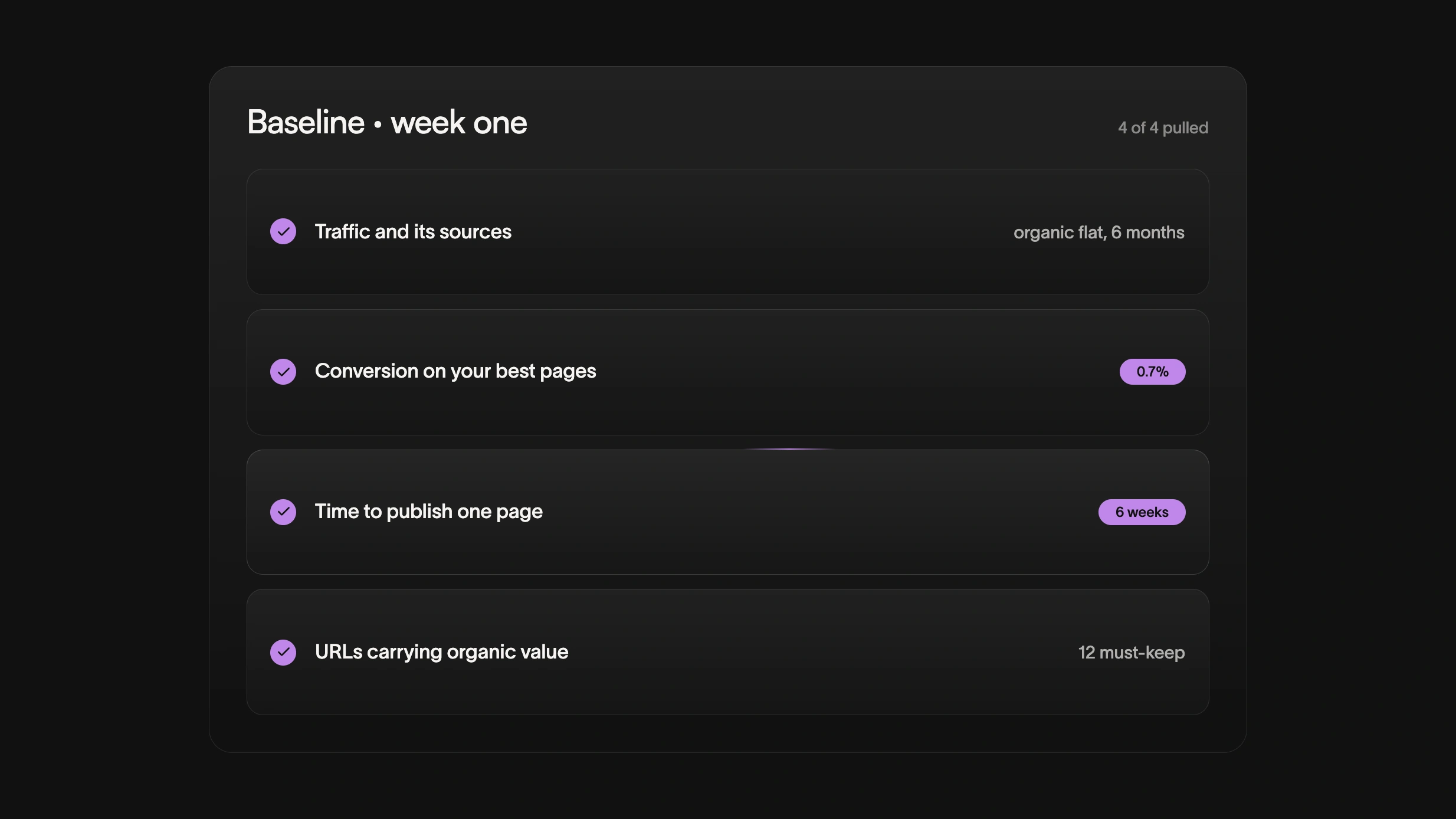
Four baselines, all pullable within a week:
- Traffic and its sources. What comes in organically, and through which URLs? A site you dislike may be carrying years of earned search equity on pages you were about to delete.
- Conversion rate on your best pages. The homepage, the top three landing pages, the pricing page. A rate below 1% on your strongest pages is a genuine warning signal. Healthy conversion on strong pages means the site is doing something right, whatever you think of the fonts.
- Publish time. How long does it take to ship one new page, from request to live? Hours, days, or months? This single number diagnoses more inherited sites than any design review.
- The URLs carrying organic value. List them. These are the assets you must protect through any change.
Two reference points keep you calm while you measure. First, minor traffic dips after site changes are normal: a decline under 10% lasting under a week is usually nothing. Second, this is why Noco starts every migration with an audit that maps existing content, URL structure, plugin dependencies, analytics baseline, and conversion performance before anything is touched. Acting before measuring is the most common way inherited sites get destroyed by their new owners.
With baselines in hand, your site will land in one of four states.
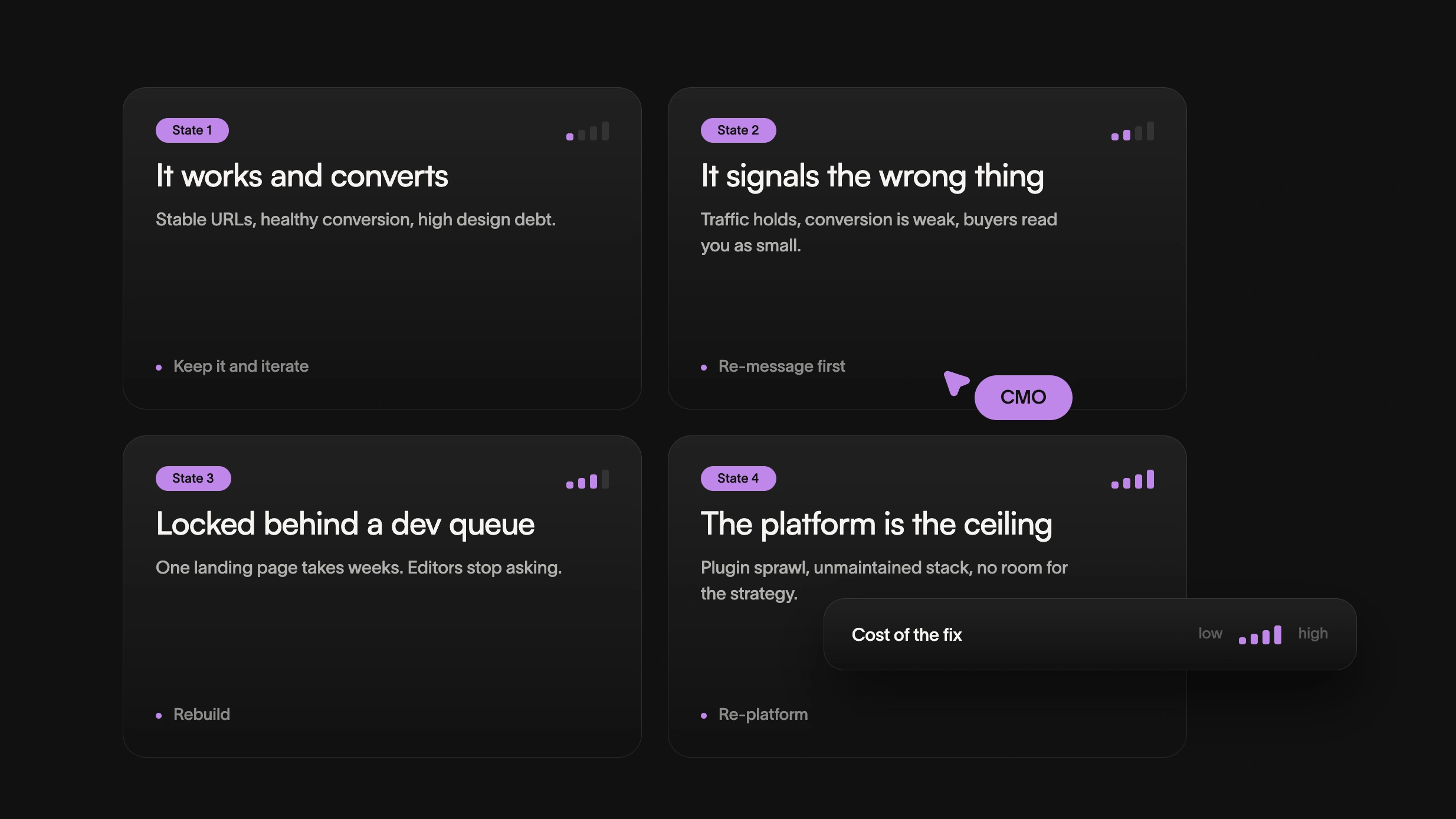
State one: it works and converts
The checklist:
- The CMS works for editors and permissions are sane
- Core Web Vitals are fixable with image optimization, caching, and modest front-end cleanup
- URL structure and redirects are stable, and organic traffic holds steady
- Design debt is high, but the data model underneath is sound
If that describes your inheritance, keep it and iterate. The rule of thumb, and treat it as such rather than as measured data, is that a focused redesign plus a performance sprint returns roughly 80% of the value at 25-50% of a rebuild budget.
The discipline here is protecting what you inherited. The site you dislike may be the best-ranking asset your company owns. Renaming URLs and retiring blog categories can erase years of organic equity in a single deploy. Skipping redirect planning is the single most common reason migrations lose rankings. Hold the slugs stable wherever the content still answers the same search intent, fix the paint, and bank the win.
State two: it works but signals the wrong thing
This is a common state for a B2B SaaS site. The site functions. The problem is what it says and to whom.
Noco's work with Prove illustrates the diagnosis. When the engagement started in 2023, prove.com had already been built in Webflow by an internal team. It worked, but it was rather basic: the design lacked the visual weight enterprise buyers expect, and the messaging led with features and technical specifications instead of business outcomes. The verdict was that the site "was not doing the job." In Prove's market, the job is specific: "A website that looks basic signals risk, and in identity verification, risk is exactly what you are supposed to eliminate." In Prove's case the fix went further than messaging: the existing Webflow site was rebuilt rather than patched, because the structural limitations in the original build would have constrained everything that came after.
Pencil is the re-messaging archetype. One site spoke to enterprise buyers, internal champions, and creative users at once, with no clear path for any of them. The fix was segmentation by ICP and a deliberate pivot to enterprise messaging. The homepage went first. Each audience got its own path.
The big levers in this category are positioning and message architecture. If your baselines show healthy traffic, weak conversion, and "they looked too small" objections in your win-loss notes, you are in this category. Re-message first. It is faster, it is cheaper, and it forces you to resolve the positioning question a rebuild would let you postpone.
State three: locked behind a developer queue
Run the publish-time test. If shipping one landing page takes weeks or months, you have found real cost, and no amount of re-messaging fixes it.
Our Edge Impulse case describes exactly this. Their site was custom-built on a rigid CMS that locked all content behind a developer queue. Every landing page, product update, or campaign asset entered a ticket queue, moved to a designer, then a developer, then a review cycle. The process routinely took months. For a marketing team trying to run campaigns at product speed, the site functioned as a brake.
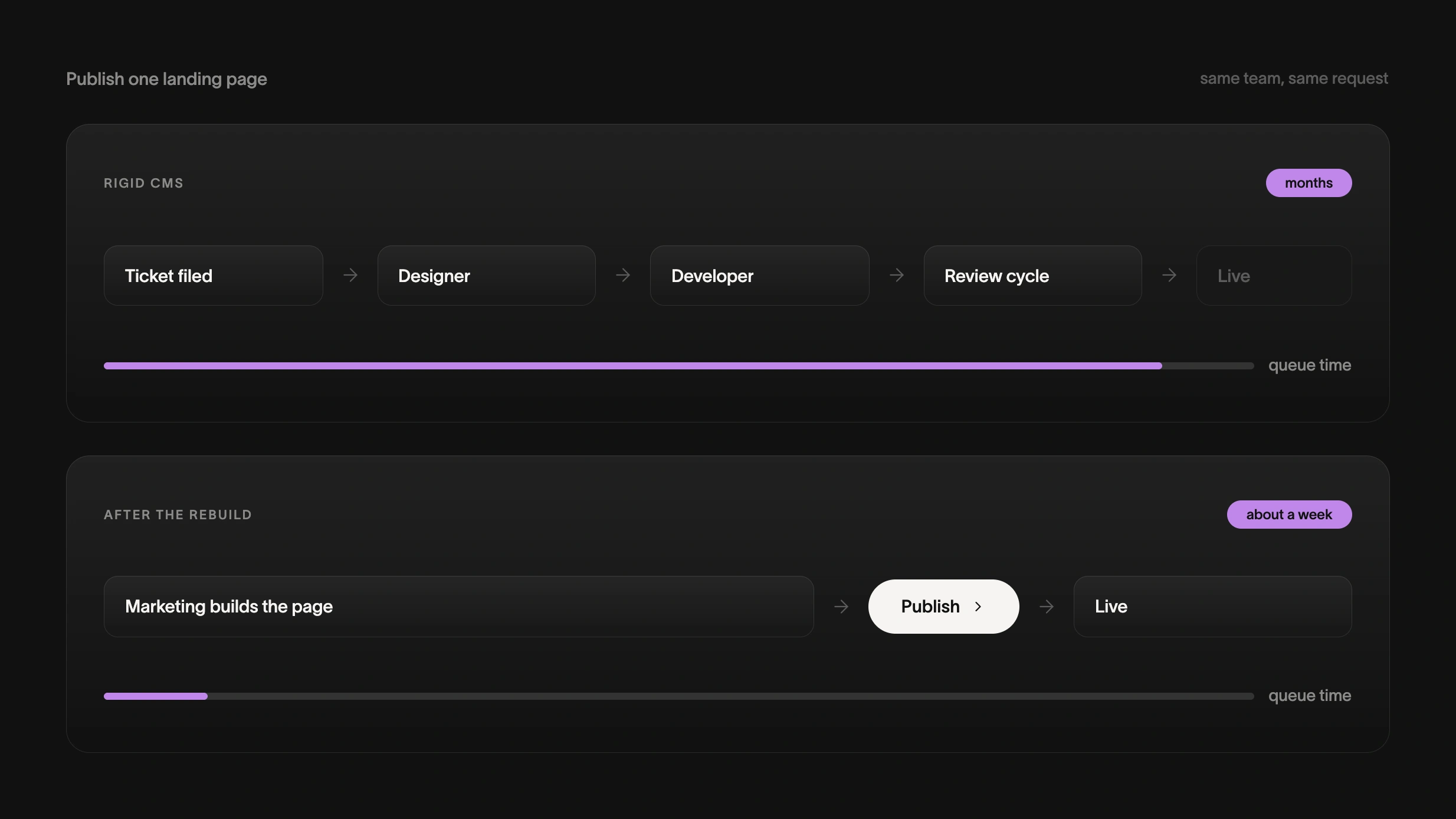
After the rebuild, the marketing team could create and launch pages independently, or submit a structured request and have it live within roughly a week. Months to a week. That shift compounds: every campaign and every product update now moves at the new speed. The partnership has since run past four years and 847 completed tasks (at the time of writing), all the way through to an acquisition by Qualcomm.
Rebuild when editors avoid publishing because the workflow is cumbersome and everything but fast-paced. Watch your own team for that behavior. When people stop requesting pages because they know the queue, the site has trained your marketing organization to do less marketing. That is a foundation problem. Rebuild.
State four: the platform itself is the ceiling
Redesign and rebuild are different operations, and the distinction sets scope and risk. A redesign refreshes design, content, and UX on the existing platform. A rebuild replaces the platform, the architecture, or both. Re-platforming is the right call when the foundation fundamentally limits performance: a legacy WordPress install where every feature is a plugin and every plugin is a liability, a custom stack nobody maintains, an architecture that cannot express the site your strategy needs.
Plan with honest timelines. Put a disciplined redesign on a healthy stack at two to five weeks, and a rebuild with content migration, integration re-wiring, and performance validation at six to ten weeks. One piece of timeline discipline sits on your side of the table: assign a single decision owner. Committee-driven design reviews stretch timelines more than any engineering constraint.
If this is your state, the path has its own playbook. Noco's WordPress to Webflow migration guide covers the audit, the redirect map, and the content model work in detail.
When to do nothing at all
An agency telling an inheriting CMO "you should probably do something about your site" has an obvious conflict of interest, so the honest default deserves a plain statement: most inherited sites should be kept and iterated. The four states above exist to find the exceptions, and finding none is a perfectly good outcome.
Three situations where acting is the mistake:
The site converts and you just dislike it. CXL has documented teams launching slick new sites and watching conversion rates plummet at launch. If your baseline shows healthy conversion, your taste is a preference, and preferences do not survive contact with a CFO. Iterating on an existing site is less risky, cheaper, faster, and more measurable than starting over.
The leak sits upstream of the website. With no demand generation and no internal content owner, a new site multiplies zero. Noco treats the absence of an internal copy owner as a poor-fit signal for an engagement, because a neglected site is often a symptom of a resourcing gap that a rebuild will never fix. If nobody owned the last site, ask who will own the next one before you commission it.
Your "cleanup" would torch the SEO equity. Covered above, worth repeating as its own warning. The urge to rename URLs and restructure everything is strongest in the first 90 days, which is precisely when you understand the site's organic value least.
One more honest note on the politics. Incremental improvement is often politically infeasible for a new leader who needs a visible win. Fine. Scope the win: a re-messaged homepage delivers the "new direction" signal at a fraction of the risk of a teardown. It works because it fixes the thing most likely to be broken and leaves the equity alone.
A closing thought on why you inherited this problem at all. Someone treated the website as a project: launched it, handed it off, moved on. A site that launches well and then stagnates loses its edge fast. Whichever state you diagnosed, the durable fix is an operating model that keeps the site moving at product speed, so the next person in your chair inherits a system that is still moving.
Not sure which state your inherited site is in? Start with the audit. Map the content, the URLs, the analytics baseline, and the conversion performance before you change anything. With that map, you make a decision; without it, you stage a demolition.




Make your next move. Today.
Momentum is created in the first conversation. When the energy matches, everything else accelerates.

.webp)


Frequently asked questions.
How do I tell the difference between a website I dislike and a website that is underperforming?

Is a full rebuild the fastest way to make an inherited website mine?
Will changing my website tank its search rankings?
How long does a website redesign or rebuild actually take?


Why B2B SaaS teams are leaving WordPress for Webflow
WordPress built the modern web. But for B2B SaaS teams that have outgrown it, the platform is becoming a liability. Here is why more and more of them are making the switch to Webflow, and what it actually takes to do it right.



Amsterdam, NL





