

-p-500.webp)


Why Intent is Replacing the Interface


Traditional UX is not dead, but it has stopped being the center of how people interact with software. The screens, menus, and click paths designers spent years refining are turning into fallback options. The primary layer is now intent: people tell a system what they want and expect the outcome back. For B2B SaaS teams, this changes what a high-performing website actually has to do.
What is intent-driven design?
Intent-driven design is an approach where a system interprets what a user wants and returns an outcome, rather than presenting an interface for that user to navigate. The interaction model has moved from click and explore to ask and receive. The design work shifts from positioning a button to shaping the result a person is trying to reach.
Three inputs now drive most interactions: natural language, context, and behavioral signals. The job becomes interpreting intent accurately, reducing ambiguity, and shaping a response the user trusts. The interface becomes one possible output, not the starting point.
.webp)
Why are interfaces becoming invisible?
Interfaces are becoming invisible because the best experiences increasingly happen in the background. Assistants act before a user asks. Apps predict needs from context. Whole workflows run without anyone opening a screen. This pattern, often called Zero UI, removes steps that used to define the experience.
The logic is simple. The less someone has to think about the interface, the faster they reach the outcome. For software that competes on speed and clarity, that is a direct advantage.
How does AI search change B2B SaaS websites?
AI search changes B2B SaaS websites by moving discovery off the page. Buyers now ask ChatGPT, Perplexity, and Google AI Overviews to compare tools, summarize categories, and recommend options. Many form an opinion before they ever reach a homepage. The website still matters, but it has to perform in two places at once: for the human who lands on it and for the engine that reads it first.
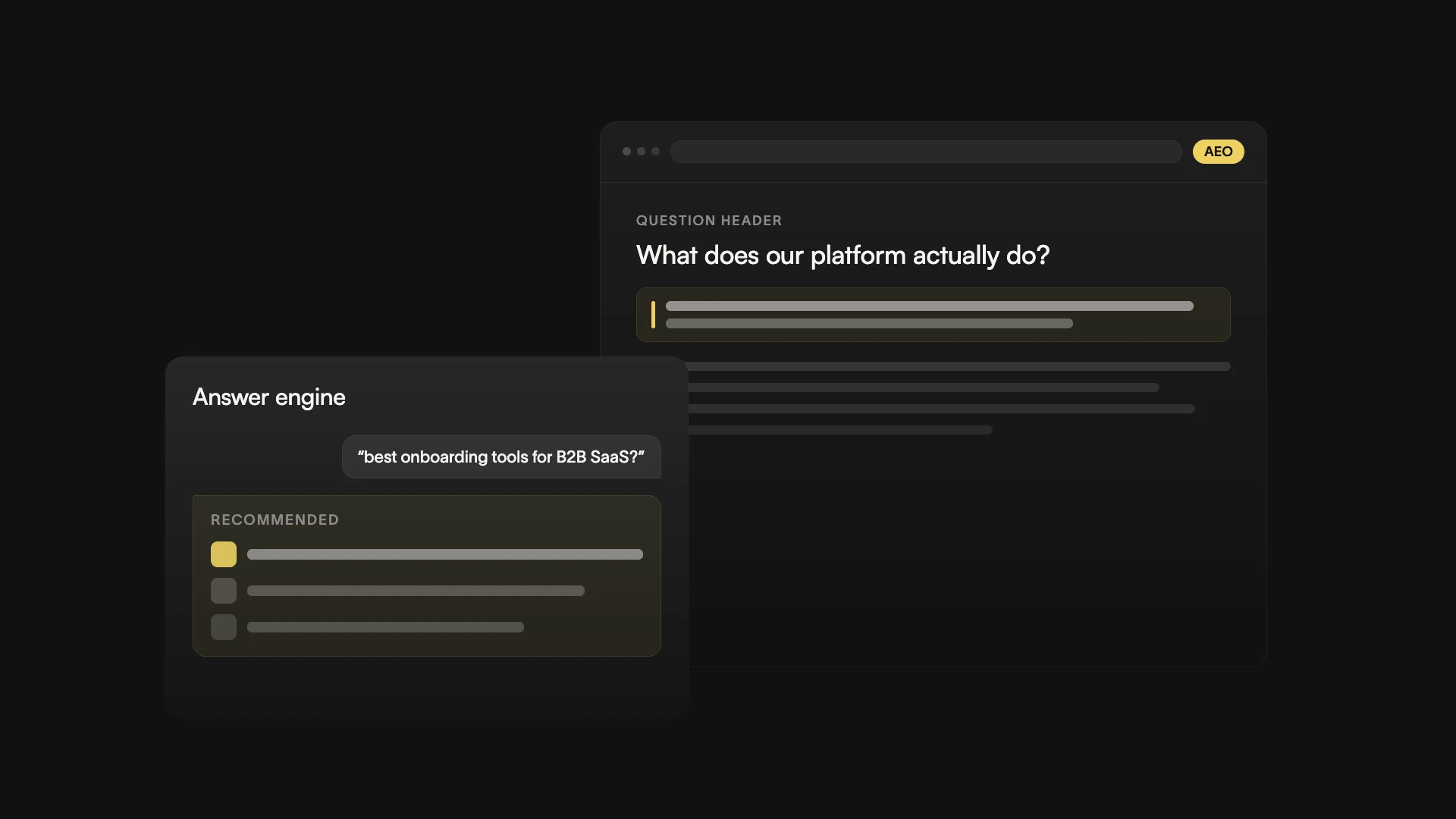
This is where answer engine optimization (AEO) becomes part of design, not a separate pass at the end. Content has to be structured so engines can extract a clear answer: direct opening sentences, question-based headers, and clean semantic chunks. A site that buries its value in clever layout loses twice, once with the engine that skips it and once with the buyer who never sees it.
Traditional UX vs intent-driven design
The shift is easiest to see when the two models sit side by side.
.webp)
How is the designer's role changing?
The designer's role is expanding from arranging visuals to shaping logic, language, and trust. Teams now design how a system responds, how a dialogue flows, and how a decision gets explained to the person relying on it. Context strategy carries as much weight as layout.
Three skills are becoming central for web and product teams:
Shaping system behavior: Deciding how a product responds to intent, not only how it looks.
Designing for trust: Making automated decisions transparent enough that users rely on them.
Writing for extraction: Structuring language so both people and AI engines understand the value quickly.
What are the risks of removing the interface?
Removing the interface introduces real risks that teams have to manage deliberately. When a system decides on a user's behalf, that user can lose visibility into how the decision was made. Trust becomes fragile the moment a result feels wrong and there is no clear path to check it.
Over-automation carries its own cost. Stripping out every step can also strip out the awareness users need to stay in control. The work is to remove friction that adds nothing and keep the friction that builds confidence.
So is traditional UX dead?
Traditional UX is not dead. Screens, buttons, and flows still exist, and for many B2B products they remain where the real work gets done. What has changed is their position in the stack. They now sit inside a system that leads with intent, rather than defining the whole experience on their own.
The teams that perform best treat the interface and the intent layer as one system. They design for the moment a buyer asks an AI engine about their category, the moment that buyer lands on the site, and the moment they decide to act. Clarity is the thread that runs through all three.
The Noco take
The move toward intent raises the bar for design rather than lowering it. When an interface can disappear, the value behind it has to be obvious in seconds, to a person and to a machine. That is a design problem, a messaging problem, and a performance problem at the same time.
At Noco we treat brand, design, and conversion as one system built for this environment. Our CRO subscription embeds AEO and experimentation into how a site performs, so your website stays legible to AI engines and persuasive to the buyers they send your way. If your site still reads like a brochure in a market that runs on intent, that gap is where growth leaks out.




Make your next move. Today.
Momentum is created in the first conversation. When the energy matches, everything else accelerates.

.webp)
Frequently asked questions.
Do you support AEO and AI search?

What is a CRO subscription, in plain English?
Is SEO and AEO considered within CRO?
What does Noco do?
.webp)

AI search is the new battleground. Webflow AEO is how you compete.
Webflow AEO is the first native closed-loop tool that measures how AI engines see your site, surfaces specific fixes, and ships them directly in Webflow. Here is what it does, why it matters for B2B SaaS teams, and what your site needs to have in place before it can create real value.


.avif)

The Third Audience: Why Your Website Needs to Be Ready for the OpenClaw Era
Websites now face a new type of visitor beyond humans and search engines: the autonomous agent. This article explains how to structure your SaaS website for OpenClaw and the Moltbook ecosystem to ensure your content is machine-readable and shareable.

Amsterdam, NL





