

-p-500.webp)


Your website is only 20% of your AEO strategy


If your AEO plan stops at schema markup, llms.txt, and a few FAQ sections, you're working on the easy part. The work that actually moves your visibility in ChatGPT, Perplexity, and Google AI Overviews mostly happens somewhere else: on Reddit, on G2, on LinkedIn, on podcasts, on third-party sites that mention you. Your website is roughly 20% of the equation. The other 80% is offsite authority, and most B2B SaaS teams have no plan for it.
This is the single biggest gap I see in how teams approach answer engine optimization. They treat it as a website task. It's not. It's a digital presence task that happens to include the website.
I unpacked a lot of this on a recent Webflow & Friends podcast appearance with Jana Pär, and the 20/80 split is the part that keeps coming up in conversations with our customers afterward. This article is the longer version of that argument.
Why AEO is mostly offsite
When an LLM answers a question, it doesn't just crawl your site and decide whether to cite you. It pulls from a much wider pool of signals: where you've been mentioned, who reviews you, what context surrounds your brand across the web. The website matters, but only as one of many sources the model weighs.
Webflow is a good example of how offsite work compounds. The platform itself sits at around 2% of the global CMS market. Yet in recent AEO observations, Webflow shows up in well over half of CMS-related AI search results. That doesn't happen because Webflow has the most websites. It happens because Webflow has invested heavily in content authority offsite: their AEO playbook, partner mentions, integration listings, podcast presence, and reciprocal coverage from tools they integrate with.
The lesson for B2B SaaS founders is direct. A clean, schema-optimized website is the foundation, not the strategy. The strategy is what happens around the website.
The 20% that lives on your site
Onsite work still matters. Without it, the offsite signals have nowhere to land. The onsite checklist is well understood by now:
- Semantic HTML with clean heading hierarchy
- Schema markup on every key page, including Article, Product, Organization, and FAQPage where relevant
- llms.txt and robots.txt configured for AI crawlers
- Answer-first content structure: each section opens with a direct answer, then expands
- Question-based section headers that match real user queries
- Author attribution with linked bios that establish expertise
- Up-to-date timestamps on every page LLMs may extract
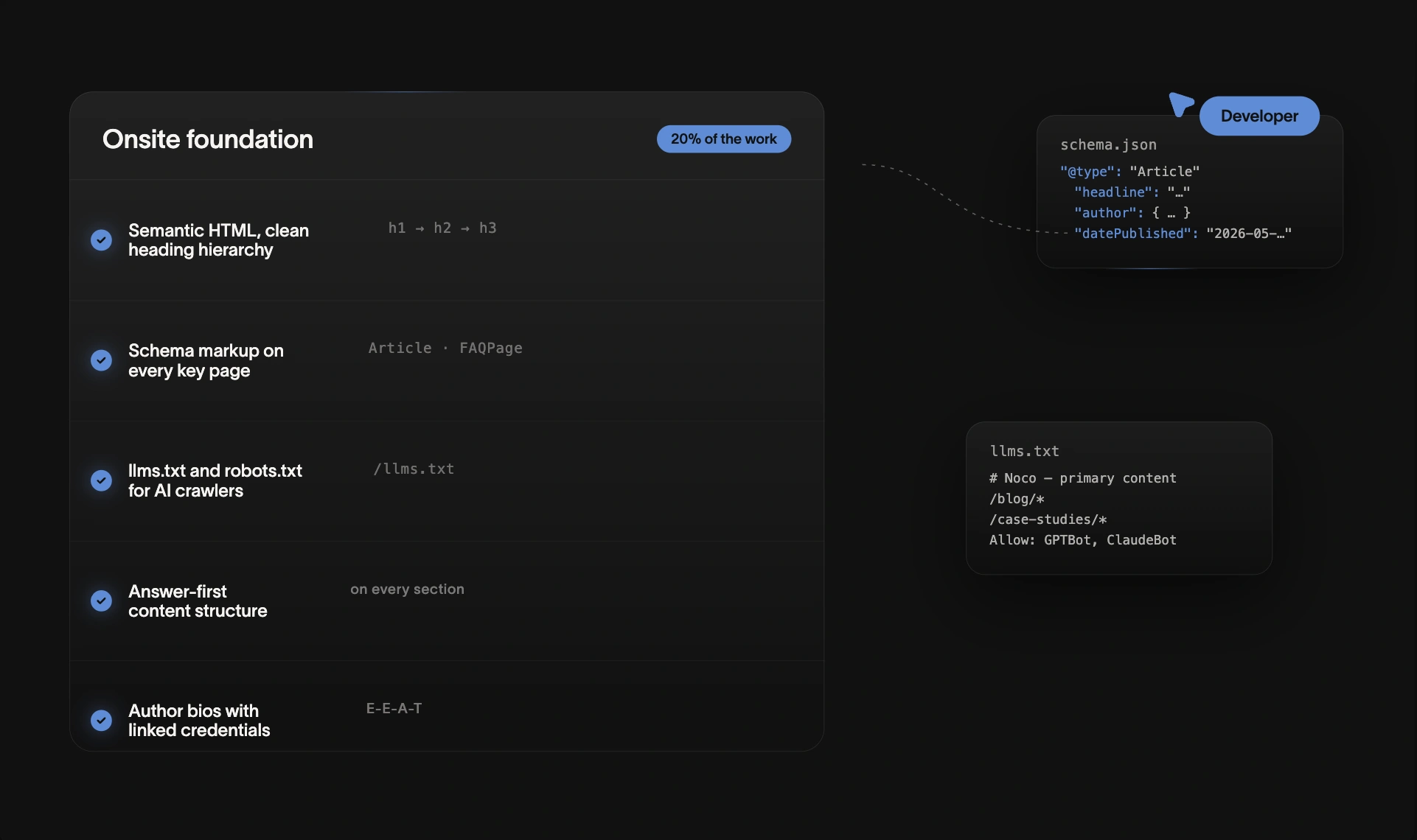
Webflow handles most of this out of the box with auto-generated schema, llms.txt, and clean semantic output. WordPress can match it with the right plugin stack. Framer can get close. The platform matters less than people think. What matters is that the structure is correct and the content directly answers questions a prospect would actually ask.
This is the 20%. It's necessary. It's not sufficient.
The 80% that lives everywhere else
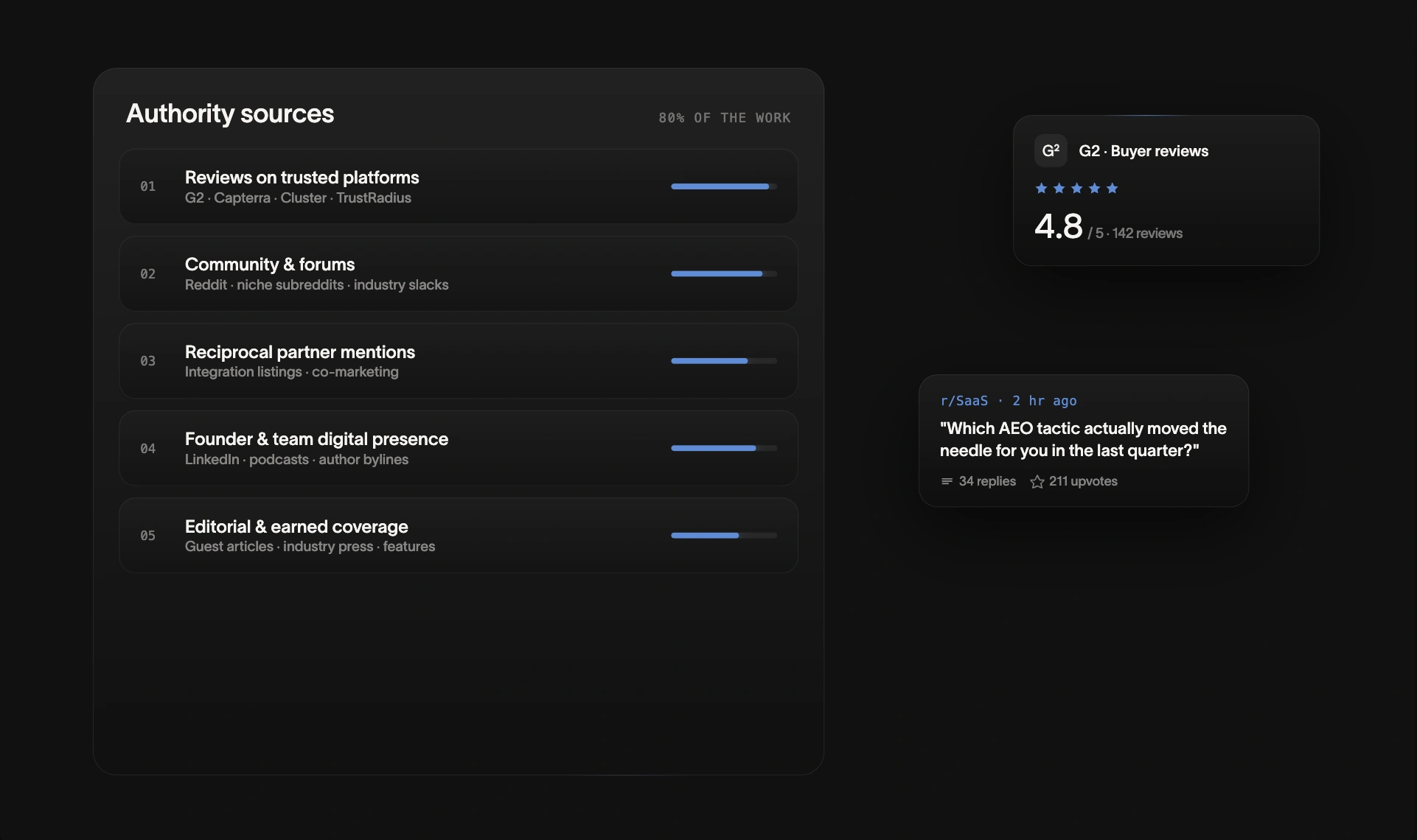
The offsite work is harder, slower, and harder to measure. It's also where the real authority comes from.
Reviews on platforms LLMs trust. G2, Capterra, Cluster, TrustRadius. Models read these as first-party validation. A handful of strong, specific reviews on the right platforms outweighs a paragraph of self-published claims.
Reddit and community forums. Reddit is one of the most cited sources in LLM answers. The reason is structural: it's raw, first-person, and full of real questions and real answers. If your product solves a specific problem, the conversations about that problem are already happening on Reddit. Participating authentically, with your name and context, builds authority that no blog post can replicate.
Reciprocal mentions with integration partners. If your product integrates with HubSpot, both companies should reference the integration on their sites and in their content. These reciprocal mentions create the kind of cross-referenced authority LLMs use to validate claims. The more integration partners cite you, the more credible you become.
Founder and team digital presence. LLMs increasingly weigh authorship and expertise. A founder with a clear LinkedIn bio, podcast appearances, and a track record of writing on the topic carries weight. A nameless brand with no human authority behind it carries less. The EEAT principle (experience, expertise, authority, trust) didn't go away with AI search. It got more important.
Editorial and earned coverage. Industry publications, partner blogs, podcast features, and guest articles all contribute. These are slow to build and impossible to fake, which is exactly why LLMs trust them.
Why teams get this wrong
Most B2B SaaS teams treat AEO as a one-time technical project. They commission an audit, fix the schema, add an FAQ section, and consider the work done. Then they wonder why they don't show up in ChatGPT three months later.
The reason is that AEO is not a project. It's an ongoing posture across every surface where your brand exists. The teams that win at AI search are the ones with active offsite work happening continuously: review collection, community participation, partner co-marketing, founder content, podcast presence, earned mentions. The website work is the easy part. It's the offsite work that compounds.
There's also a measurement problem. Offsite signals are harder to track than onsite changes. You can't see a direct line from "we answered 30 Reddit questions" to "we appeared in Perplexity for our category." But the correlation is real, and it shows up over time in manual prompt testing across LLMs.
What to actually do this quarter
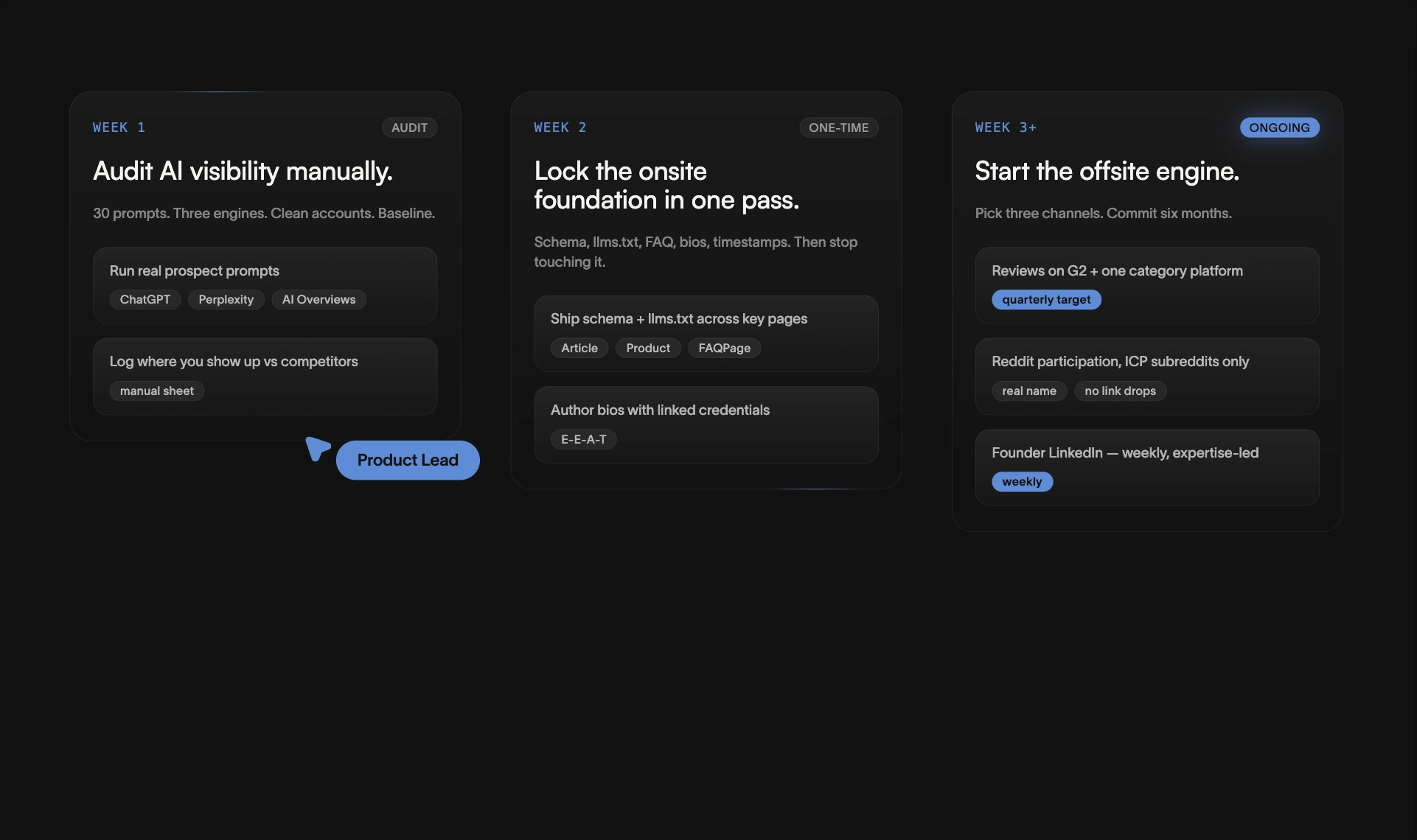
Most teams need to rebalance, not add more work. Here's the practical order I'd run if I were starting from scratch in a B2B SaaS company today.
Week 1: audit your AI visibility manually. Open ChatGPT, Perplexity, and Google AI Overviews in incognito or a clean account. Run 20 to 30 prompts a real prospect would type. Note where you appear, where you don't, and which competitors come up instead. This is your baseline. Repeat monthly. There's no good automated tool for this yet, so manual checking is the work.
Week 2: lock the onsite foundation in one pass. Schema markup on every key page, llms.txt configured, FAQ items on the pages that need them, author bios with linked credentials, timestamps up to date. This is a one-time block of work, not an ongoing effort. Get it done, then stop touching it unless something breaks.
Week 3 onward: start the offsite engine. Pick three offsite channels and commit to them for at least six months. The default stack for most B2B SaaS teams should be:
- Reviews on G2 and one category-specific platform. Set a quarterly target. Ask happy customers directly.
- Reddit participation in the two or three subreddits where your ICP actually hangs out. Answer questions in your area of expertise without linking back to your site. Use a real name and a real bio.
- Founder or team LinkedIn presence with weekly posts that demonstrate expertise, not promote the product.
Add a fourth channel once the first three are running: podcast appearances or guest articles on industry publications. These compound slowly but they're the highest-trust signals you can build.
What to stop doing: publishing weekly blog posts purely for SEO keyword targeting, paying for backlink packages, adding more FAQ accordions to your homepage, hiring an AEO agency that only audits your site. None of these move the 80%.
The teams that will dominate AI search over the next two years are not the ones with the cleanest schema. They're the ones building authority everywhere their prospects look.
If your team needs help building the 20% correctly so the 80% has somewhere to land, that's the part we do at Noco. The Enterprise Website sprint puts AEO into the architecture from day one. The CRO subscription keeps the onsite work compounding while you focus the offsite effort where it counts.


Make your next move. Today.
Momentum is created in the first conversation. When the energy matches, everything else accelerates.

.webp)
Frequently asked questions.
What does Noco do?

Who is Noco for?
What happens after launch?
Do you support AEO and AI search?
Is SEO and AEO built into PRO?
Is SEO and AEO considered within CRO?
Is SEO and AEO built into the Enterprise Website sprint?
Is SEO and AEO built into the Startup Website sprint?
.webp)

AI search is the new battleground. Webflow AEO is how you compete.
Webflow AEO is the first native closed-loop tool that measures how AI engines see your site, surfaces specific fixes, and ships them directly in Webflow. Here is what it does, why it matters for B2B SaaS teams, and what your site needs to have in place before it can create real value.
.avif)
How to Make Your Website AI-Friendly with llms.txt
Picture this: A prospect asks ChatGPT about your B2B SaaS product. The AI pulls data from across the web and... finds nothing useful. Or worse, it shows outdated third-party content instead of your actual site. This happens more often than you'd think. But there’s a dead-simple fix.