



-p-500.webp)


AI search is the new battleground. Webflow AEO is how you compete.

.webp)
Webflow AEO, launched on April 13, 2026, is the first native closed-loop answer engine optimization tool built directly into a website platform. It is currently in private beta for Enterprise customers, and it changes what is possible for B2B SaaS marketing teams that want to stay visible as AI reshapes how buyers discover products.
This is not a bolt-on analytics tool or a third-party integration. It measures how AI engines see your site, generates specific recommendations, and lets you ship fixes directly from Webflow without touching a separate tool or briefing a developer. As Webflow's Chief Product Officer Rachel Wolan put it at launch: the problem for most teams is not that they do not understand AEO matters. It is that they cannot execute on it fast enough because their tools were not built for it.
As Webflow Enterprise partners, we have been watching this space closely. This article breaks down what Webflow AEO actually does, what the Maturity Model framework means for your team, and what your site needs to have in place before any of this tooling creates real value.
What is Webflow AEO and how does it work?
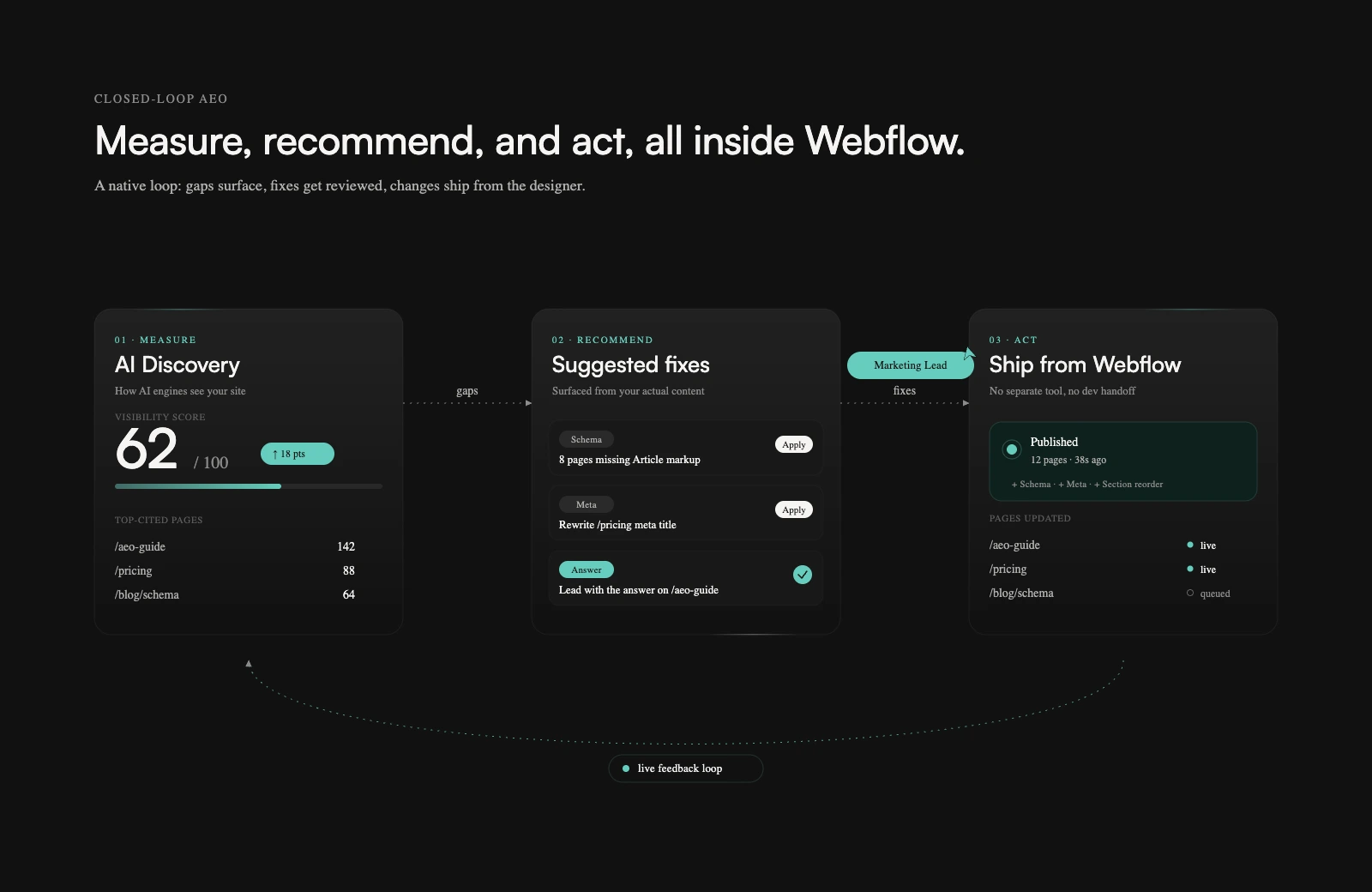
Webflow AEO is a closed-loop system built around three stages: measure, recommend, and act. All three happen natively inside Webflow, inside the same environment where your site is designed and built.
Measure: Inside the Analyze panel, a new AI Discovery section shows your overall visibility score, which tracks the percentage of prompts and topics where your brand appears in AI-generated responses. You can see which pages are being cited most frequently by AI engines, which specific prompts you are showing up for, and how AI-referred visitors are behaving on your site. That last point matters: early evidence shows AI-referred visitors convert at significantly higher rates than typical search traffic. Webflow AEO now gives you a way to measure that directly.
Recommend: The platform analyzes your entire site and surfaces opportunities to improve visibility. Most of these are technical: missing meta titles, missing or incomplete schema markup, content that is not structured in a way AI systems can parse clearly. Instead of manually auditing page by page, the tool surfaces them automatically. And critically, it does not just identify the problem. It generates specific suggested fixes based on the actual content of each page and your stored brand context.
Act: Suggested fixes can be reviewed, modified, and then applied directly to your site. Because it is all native to Webflow, changes can be rolled out at scale without manual dev work or external tooling. What Webflow's own team had to figure out manually when rebuilding webflow.com, the product can now surface in minutes for any Enterprise customer.
What is the Webflow AEO Maturity Model?
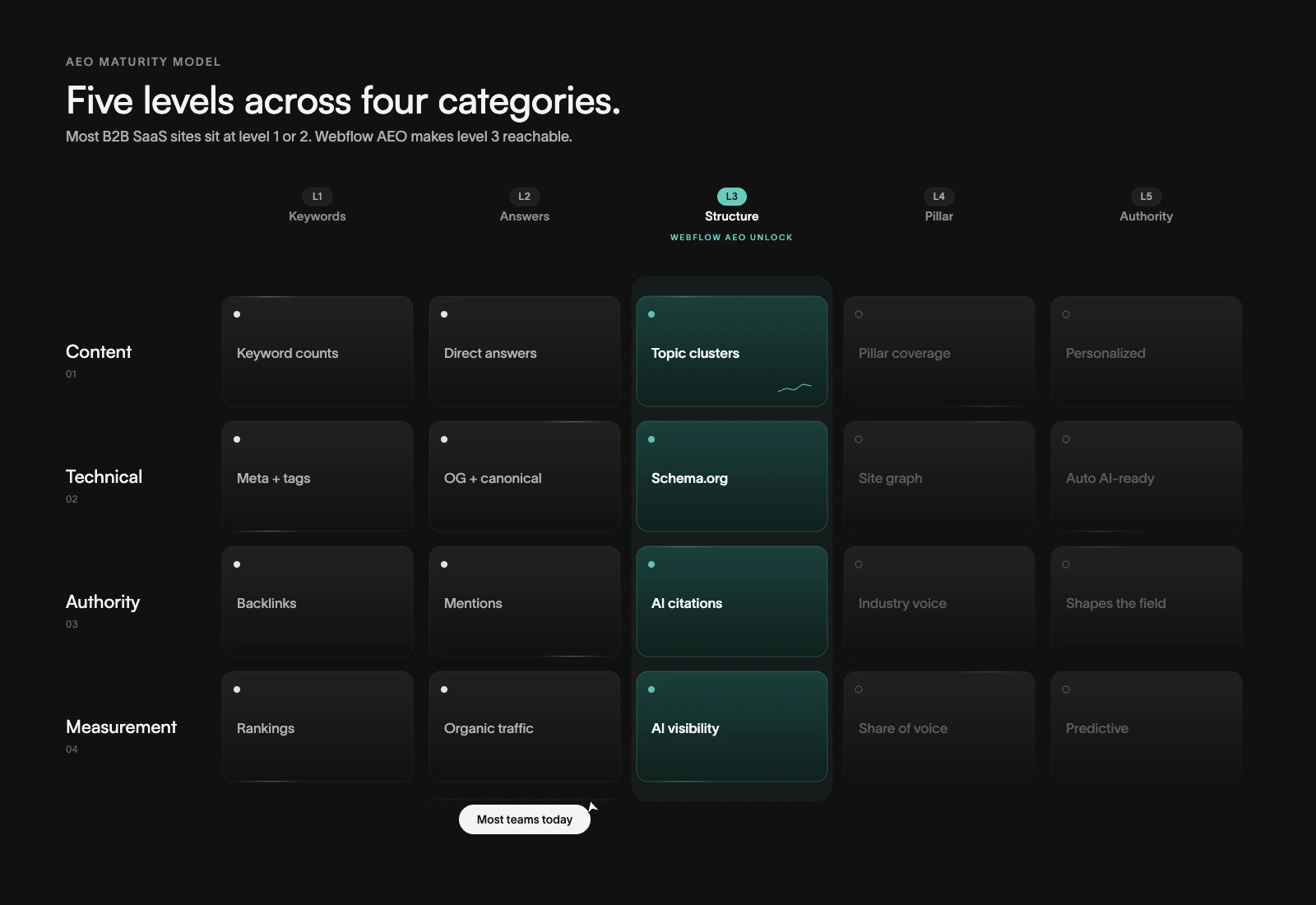
The AEO Maturity Model is a framework Webflow developed to help marketing teams understand where they stand and what to work on next. It maps across four categories: content, technical, authority, and measurement. Each category has five levels, from basic keyword-focused approaches to fully programmatic, personalized AEO at scale.
Understanding the model matters because it sets realistic expectations. No tool, including Webflow AEO, closes the gap by itself. The tool accelerates what is already structurally possible on your site. If the foundation is weak, the acceleration is small.
Content moves from keyword counting toward complete, clustered answers to real ICP questions. The endgame is personalized content that speaks to specific segments, accounts, and individuals while maintaining brand voice. When Webflow refreshed their own content using this approach, they moved from manually updating fewer than 50 articles per year to optimizing dozens monthly, and saw a 40% uplift in organic traffic for updated content within days.
Technical moves from basic SEO tags toward auto-generated AI-friendly site structure and schema markup. The opportunity here is significant: 88% of sites have not implemented schema.org markup, while 73% of first-page Google results use it. Getting this right is where much of AEO visibility is won or lost.
Authority moves from backlinks toward consistent citation as an authoritative source across AI-prioritized platforms: Reddit, Quora, YouTube, industry publications. Advanced authority means your research shapes industry conversations and your expertise shortens sales cycles because prospects already trust your voice before they reach your site.
Measurement moves from keyword rankings toward share of voice in AI-generated answers. The most sophisticated level is predictive, anticipating shifts in AI-driven behavior before competitors capture the opportunity.
The five maturity levels are: Keywords, Answers, Structure, Pillar, and Authority. Most B2B SaaS teams building on Webflow today are operating at level 1 or 2. Getting to level 3 requires structural investment in schema, content architecture, and topic ownership. Webflow AEO makes level 3 significantly more accessible for Enterprise teams.
Why does AEO matter for B2B SaaS marketing teams right now?
The data from Webflow's own survey of 100 marketing leaders and 300+ practitioners is striking. 93% of marketing leaders agree AEO will be somewhat or extremely important to their company's success in the next two years. Only 25% of practitioners say they fully understand what it is. 42% describe it as a moving target where the rules keep changing.
That gap between strategic importance and practical understanding is where most teams are stuck. And it has real consequences. HubSpot, one of the most mature B2B content operations in the world, saw organic traffic decline 36% in a single month as AI-driven zero-click search expanded. Bain estimates overall SEO traffic has declined 15 to 25% broadly. The silver lining is that LLM-referred visitors convert between 4.4x and 23x more than typical SEO traffic. Less volume, more qualified.
The implication for B2B SaaS teams is clear: optimizing purely for traditional search is a diminishing return. The teams that build AI search visibility now will compound that advantage as AI continues to expand its share of the discovery layer. ChatGPT still represents less than 2% of search share today. That window to establish authority before the space gets crowded is closing.
What does your site need before Webflow AEO creates real value?
This is the part most articles about Webflow AEO skip. The tool is only as effective as the foundation it has to work with. Based on the Maturity Model and what the product actually surfaces, here is what needs to be in place:
Clean entity logic and consistent brand language. AI engines build a model of what your brand does and who it is for by parsing content across your site and external sources. If your messaging is inconsistent between pages, your brand will be misrepresented in AI responses regardless of technical optimization.
Schema markup. Webflow AEO will surface schema gaps and generate suggestions. But if your site has never had structured data, the volume of recommendations will be significant. Getting schema foundations right before the tool rolls out widely means you are optimizing rather than starting from scratch.
Answer-first content structure. AI engines extract answers from the first one to two sentences of each section. If your content buries the answer after several paragraphs of context, it will not be cited. Every section of every key page needs to lead with the direct answer to the implied question.
Topic coverage depth. AEO rewards topic ownership, not individual pages. A single well-written article on your category does not create authority. A structured cluster of content covering the full range of ICP questions does. Moving from keywords to answers requires deliberately mapping content to the questions your buyers ask at every stage of the buying process.
Measurement baseline. Webflow AEO measures AI visibility over time. Without a baseline established before you start optimizing, you cannot quantify the impact of changes. Getting tracking in place now means you will have data to act on when the tool is fully available.
How does Webflow AEO fit into working with Noco?
Noco operates as an embedded growth partner for B2B SaaS and tech scaleups building toward enterprise grade. Our model is built around long-term monthly partnerships rather than one-off projects: design, Webflow development, and CRO running together as one continuous system. The PRO subscription is the flagship expression of that model, and Webflow AEO fits directly into it.
We already work with Webflow Enterprise customers including Prove and Pencil, and we are exploring Webflow AEO in early stage with both. What we are seeing confirms what the Maturity Model predicts: the teams that benefit fastest are the ones where the technical and content foundations are already clean. AEO tooling accelerates what is structurally possible. It does not compensate for foundations that are not there.
We have been building those foundations into every Enterprise project for some time: schema implementation, answer-first content structure, question-based section headers, semantic HTML, and AEO-ready page architecture from day one. What Webflow AEO adds is a native measurement and recommendation layer that closes the feedback loop. Instead of running manual audits and translating findings into Webflow tasks, the platform surfaces gaps automatically and generates suggested fixes that can be reviewed and shipped directly.
In a PRO subscription, this becomes part of a seamless monthly workflow: AEO insights feed the same prioritization queue as CRO experiments, development tasks, and design iterations. Continuous optimization across all dimensions, with no handoffs between separate tools or separate teams. When Webflow AEO is fully rolled out to Enterprise customers, it will be integrated into that workflow from day one for every customer we work with.
If you want to understand where your current Webflow setup stands on the AEO Maturity Model and what it would take to move to the next level, that conversation is worth having now. Book a call with us and we can map it out.




Make your next move. Today.
Momentum is created in the first conversation. When the energy matches, everything else accelerates.

.webp)

Frequently asked questions.
Do you support AEO and AI search?

Are you a Webflow Premium Partner Enterprise?
Should we choose Webflow or Framer?
What happens after launch?


.avif)

The Third Audience: Why Your Website Needs to Be Ready for the OpenClaw Era
Websites now face a new type of visitor beyond humans and search engines: the autonomous agent. This article explains how to structure your SaaS website for OpenClaw and the Moltbook ecosystem to ensure your content is machine-readable and shareable.

Amsterdam, NL





