



-p-500.webp)


Series A website math: the three costs a slow site charges you every funding round


This is a diagnostic framework for post Series A B2B SaaS founders and heads of marketing to price what a slow website actually costs, in operational drag, stale narrative, and lost conversion, and to decide whether fixing it now is worth it.
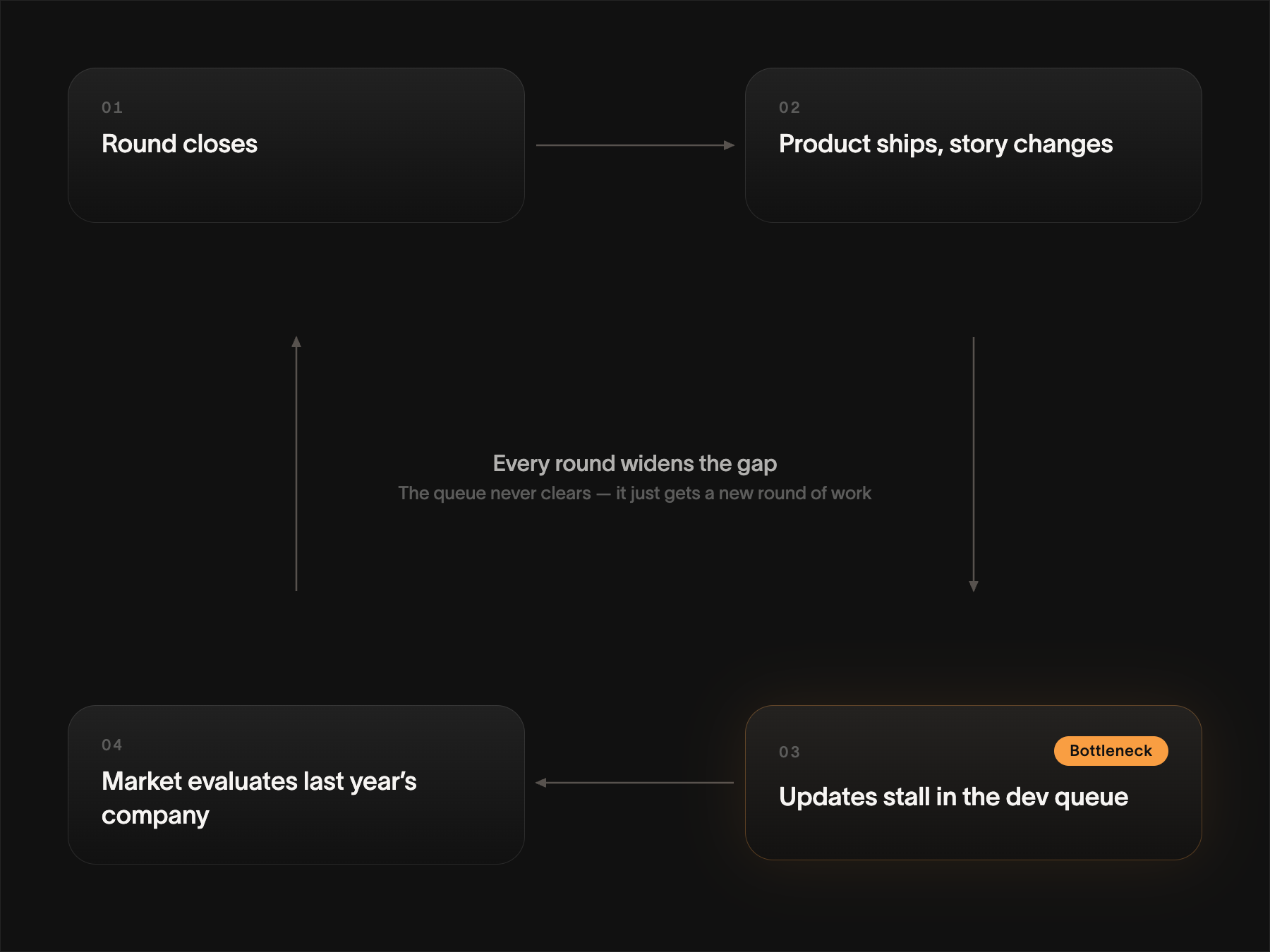
The scene repeats across nearly every seed to Series B company we work with. The round closes. Over the next twelve months the company ships three major features, signs two partnerships, hires a sales leader, and repositions for a bigger buyer. Every one of those changes needs to reach the website. Every one of them lands in a developer ticket queue. By the time the site reflects the company, the company has moved again.
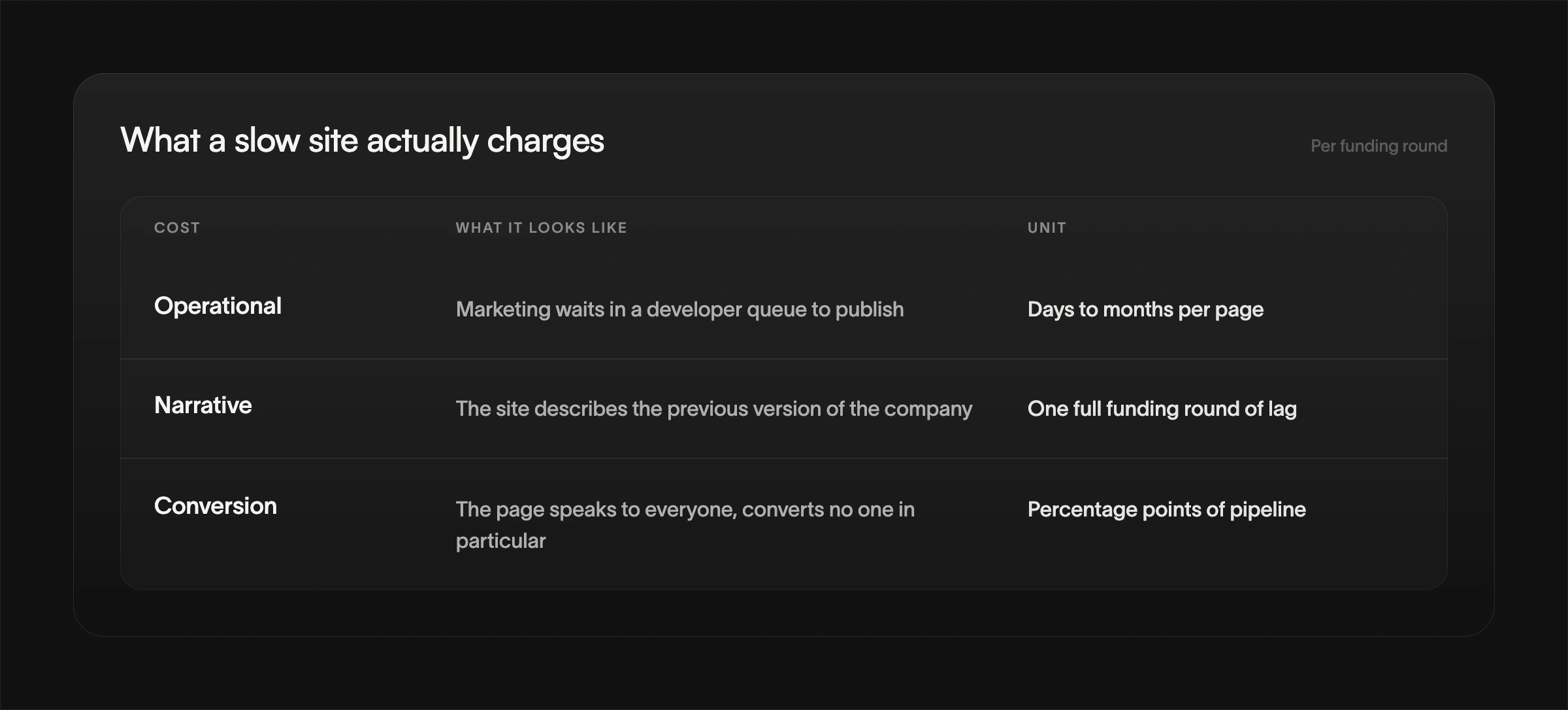
Founders measure website cost in milliseconds, because that is where the public data points at. For a company on a funding cadence, the meaningful unit is the round. A slow website behaves like a tax collected every time you raise: quiet, compounding, easy to ignore until someone audits it. This article prices that tax in three parts: what it costs when marketing cannot ship, what it costs when the site tells last year's story, and what it costs when a fast, polished page converts no one in particular.
Why is "page speed" the wrong way to measure a Series A website?
Because almost every hard number behind the page speed argument comes from e-commerce, and a B2B SaaS deal does not behave like a checkout. Yottaa's 2025 Web Performance Index analyzed over 500 million visits across more than 1,300 e-commerce sites and found that 63% of visitors bounce from pages taking over four seconds to load. The famous Amazon figure, every 100ms of latency costing 1% in sales, dates from a 2006 retail experiment. Both are real. Neither describes a purchase with eight stakeholders and a six-month cycle. When the decision takes two quarters, the first 400 milliseconds matter less than the first meeting being right.
The SEO version of the argument is weaker than most articles admit. Industry testing suggests Core Web Vitals act as a tiebreaker between similarly relevant pages, and the correlation studies behind stronger claims do not isolate causality. Passing the thresholds gives a similar page an edge. It does not lift a weaker page past a stronger one. Even the edge arrives slowly: Google reads a 28-day rolling window of real-user field data, so a genuine speed fix takes four to six weeks to register in Search Console.
The reframe we keep arriving at with scaling SaaS teams: anyone can build a site now, including AI. The scarce work is positioning, conversion thinking, taste, and maintenance. Which means "slow" needs a more precise definition than "load time." For a Series A company, slow shows up in three places, and milliseconds are the smallest of them.
Cost 1: What does it cost when marketing cannot ship without a developer?
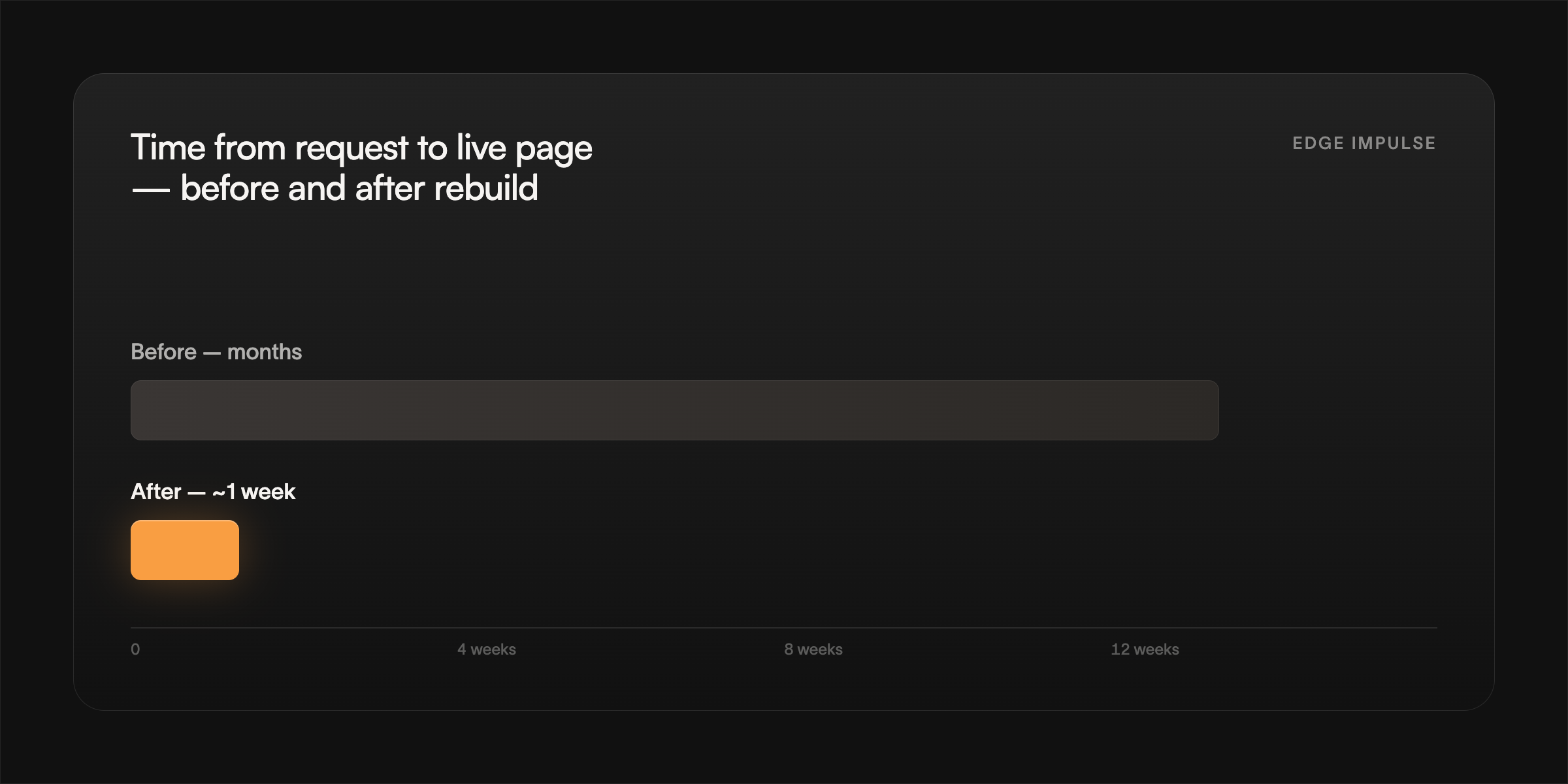
It costs the difference between iterating weekly and iterating quarterly, and we can put a number on it. When Edge Impulse came to us, their site was custom-built on a rigid CMS that locked every content change behind a developer queue. A new landing page or campaign asset entered a ticket system and routinely took a long time to go live. After we rebuilt the site as a structured system, the marketing team launched pages independently, or submitted a structured request and had it live within roughly a week. Months to one week. That shift changed how the team could operate entirely. A campaign idea in January no longer launched in April.
Teams building predictable inbound iterate on pages and messaging weekly; teams stuck in quarterly release cycles watch their tests pile up unrun. Marketing wants to move fast. The product team, reasonably, wants to protect the core product and its deploy pipeline. The website sits between them, and that is exactly where it stalls.
We see the same buying trigger again and again in seed to Series B companies: a platform they have outgrown, usually WordPress or a founder built stack, plus a launch with a date attached. The date is what exposes the queue. A repositioning that must go live the morning of a funding announcement does not tolerate a three-week ticket backlog. If that describes your stack, the WordPress to Webflow migration pattern is worth reading before the next date lands on your calendar.
Cost 2: What happens when your site tells last year's story?
The market buys the previous version of your company. Fast growing SaaS companies lose momentum in a specific gap: the product evolves, the team scales, partnerships stack up, and the website still tells last year's story. Nobody plans this. It happens one deferred update at a time.
The mechanism compounds with the funding cadence. Edge Impulse changed shape three times in four years: developer-focused startup, enterprise platform, acquisition target for Qualcomm. Every round brought new features. Every feature needed to be on the site. Run that for two rounds on a system that is causing friction for your marketing team, and the gap between what you sell and what your site says grows rapidly. A prospect who evaluates you off the website is evaluating a company that existed twelve months ago.
Then multiply the gap by your acquisition spend. Every paid click and every organic visit lands on a page that is a full round behind the product. You are paying current CAC to advertise last year's company. No isolated study proves this line item, and it does not need one. It follows directly from spend meeting stale pages, and anyone running paid for a repositioned SaaS product has felt it. We covered the static version of this failure in The Real Cost of a Static Web Design in B2B SaaS; the funding round version runs the same loop at a faster tempo.
Cost 3: Why does a fast, good-looking site still convert no one?
Because speed and polish cannot fix a page that speaks to everyone at once. When Pencil came to us, their site was talking to everyone and converting no one in particular. Enterprise buyers, internal champions, and creative users all landed on the same messaging, and none of them found a clear path to the value that mattered to them. The page loaded fine. It just answered nobody's question first.
We rebuilt the site in six weeks against a hard launch deadline, segmented the messaging by ICP, and stayed embedded to iterate. Site conversion moved from under 1% to over 2% within the first few months. Later, when Pencil's commercial strategy shifted toward enterprise, we pivoted the homepage messaging to match, and conversion doubled within weeks of that single repositioning.
Two things make that number worth pausing on. First, it is a genuine B2B SaaS conversion figure, in a field where nearly all published conversion data comes from retail checkouts. Second, the doubling came from messaging, structure, and audience segmentation, on a site that already loaded fast. If your analytics show healthy traffic and a flat conversion line, the diagnostic question is the one we put in Who Are You Actually Designing For?: which single visitor is this page built to convince?
Does fixing it actually compound, or is it a one-time bump?
The published numbers say it compounds, with the caveat that these are operating results and rebuilds never happen in a vacuum. Since launch, Pencil's organic search sessions grew 155%, LLM-referred traffic grew 522%, and site conversion doubled. Edge Impulse ran as a four-plus-year engagement: 847+ subscription tasks completed and 300%+ growth in page volume, sustained through a Series B, an enterprise pivot, and eventually the Qualcomm acquisition.
Both companies were also raising, rebranding, and growing during those periods. Treat the numbers as directional proof of an operating model in which the site ships at the speed of the business and gains stack across quarters.
The 522% figure is the freshest signal in the set. LLM-referred traffic means the site's structure and content hierarchy are being surfaced inside AI-generated answers. Speed of relevance now feeds a distribution channel that did not meaningfully exist two years ago, and a site stuck a round behind the product is invisible there too. Your website is only part of that equation, roughly 20% of it, but it is the part a rebuild controls.
When is a slow website not your real problem?
Sometimes the honest answer is: leave the site alone this quarter. Four cases where the three-cost framework says wait.
- You have no inbound flow to convert. Speed multiplies zero. A faster, sharper site converts the demand you already have. If demo requests are near zero, the constraint is demand generation, and a rebuild will produce a beautiful page that nobody visits. Fix the traffic problem first.
- The leak sits after the form. A secret shopper study submitted forms to 433 B2B SaaS companies. Only 7% responded within five minutes, and 55% had not responded within five business days. A fast site handing leads to a slow sales team wastes the win. Check your speed to lead before you blame the page.
- Nobody owns the content. We treat "no internal copy or content owner" as a poor fit signal, and we say so before a project starts. A stale site is sometimes a symptom of a resourcing gap, and a rebuild alone will not fix it. Twelve months later the new site tells last year's story too. Someone inside the company has to own the words.
- You are below the speed floor. The floor is real, just smaller than the headlines suggest. Catchpoint's 2025 SaaS benchmark found only 6 of 19 leading SaaS websites load in under three seconds, and when mobile load time slips from one second to three, bounce rate increases 32% per Google's own research. Speed shapes the first moment of trust for a visitor arriving from search or paid. Treat load time as the floor; the three costs above set the ceiling.
Price your own website tax
Run the audit before the next round does it for you. Three questions, one per cost. How many days from "marketing wants a page" to "the page is live"? Does your homepage describe the company you are today or the one from your last raise? And can your best-fit visitor find their value proposition within one scroll?
If two of the three answers are uncomfortable, that is what the tax costs you per round. Our model is built for exactly this shape of problem: a sprint sets the foundation, an embedded subscription keeps the site moving at the speed of the product, round after round. Edge Impulse ran that model through a Series B, an enterprise pivot, and an acquisition. Talk to us and we will help you price the three costs against your own numbers. Bring your ticket queue age. That number usually settles the conversation.




Make your next move. Today.
Momentum is created in the first conversation. When the energy matches, everything else accelerates.

.webp)



Frequently asked questions.
How do I know if my website is slowing my company down, beyond page speed?

Does page speed matter at all for a B2B SaaS website?
When is rebuilding the website the wrong move after raising?
What results can a Series A company realistically expect from fixing this?


Why B2B SaaS teams are leaving WordPress for Webflow
WordPress built the modern web. But for B2B SaaS teams that have outgrown it, the platform is becoming a liability. Here is why more and more of them are making the switch to Webflow, and what it actually takes to do it right.



Amsterdam, NL





