


-p-500.webp)


The AI-Invisibility Audit: Why Your AI Startup Isn't in the Answer, and the 3 Checks That Tell You Why


This article shows founders and marketers at AI startups how to diagnose why their company is absent from ChatGPT and Claude vendor recommendations, using a three-bucket self-audit and three concrete checks.
Open ChatGPT. Type the category you built your company to serve and ask for the best tools in it.
For most AI startups, it never does. A competitor's name sits there instead, delivered with the flat confidence of a machine that has never heard of your business. The cobbler's children have no shoes, and the AI company has no AI visibility.
But you can hold the panic. Absence from AI answers has a short list of very curable causes. All of them are diagnosable, most are fixable, and you can rule the big ones in or out in an afternoon's work. The three checks are below. But let's start with why this test matters more than it did a year ago.
Why is the AI answer suddenly the thing that matters?
Because the shortlist your prospects are making now is being assembled inside the chat window, before anyone visits your site.
The numbers behind that claim. 51% of B2B software buyers now start their research with an AI chatbot more often than with Google, per G2 data. 6sense puts the broader figure even higher: 94% of B2B buyers used generative AI tools somewhere in their purchase process. And that first answer moves real money. 1 in 3 buyers purchased from a vendor they had never heard of before their LLM of choice had surfaced it. 69% ended up choosing a different vendor than they originally planned after this guidance from their LLM.
Stack that against another finding 6sense has published: 95% of winning vendors were already on the buyer's day-one list. Deals are basically decided for the greatest part at shortlist formation. If shortlist formation happens inside an AI answer and you are absent from it, you lose deals you never knew existed.
One more effect worth naming. G2's research also found that 85% of buyers think more highly of a vendor when AI includes them in an answer. Appearing in the answer works as a trust signal on its own. Presence is the point.
Which of the three buckets are you in?
Run five to ten prompts across ChatGPT, Claude, or your AI of choice: your category, your buyer's core problem, "best tools for X". You will land in one of three buckets:

Bucket three has a structural explanation, so stop blaming randomness. Only 11% of domains are cited by both ChatGPT and Perplexity. The engines pull from different source pools and cite different page types, so uneven presence across platforms is the default state, and each platform needs its own read.
A note on scoring. Visibility in AI search is a mention rate: how often your brand appears across many responses to many different prompts. There is no position #1 to win in ChatGPT. Score frequency across the full prompt set. Two stats explain why most readers have never run this exercise. Only 16% of Fortune 500 companies track AI search performance at all, per AirOps data cited by Cintra. And the spread between companies is enormous.
Once you know your bucket, run the three checks.
Check 1: are you letting the crawlers in?
Start here. It takes ten minutes and explains total invisibility more often than anyone likes to admit.
Open your server logs and search for the AI crawler user-agents: GPTBot (OpenAI), ClaudeBot (Anthropic), PerplexityBot, and Google-Extended. If they never visit, your content cannot be picked up, and the cause is frequently a single robots.txt rule blocking them. Some teams added the block deliberately in 2023 during the training-data backlash and forgot about it. Others inherited it from a template, a security plugin, or a well-meaning developer.

This happens constantly. Omniscient Digital found that 34% of B2B SaaS companies block AI crawlers via robots.txt. A third of the market has removed itself from AI answers entirely, by configuration.
If you find a block, the fix is a one-line edit and a redeploy. If the crawlers already visit and you still sit in bucket one, keep going.
Check 2: does your content read like a pitch deck or a fact?
LLMs cite pages they can extract facts from. Most startup websites give them nothing to extract.
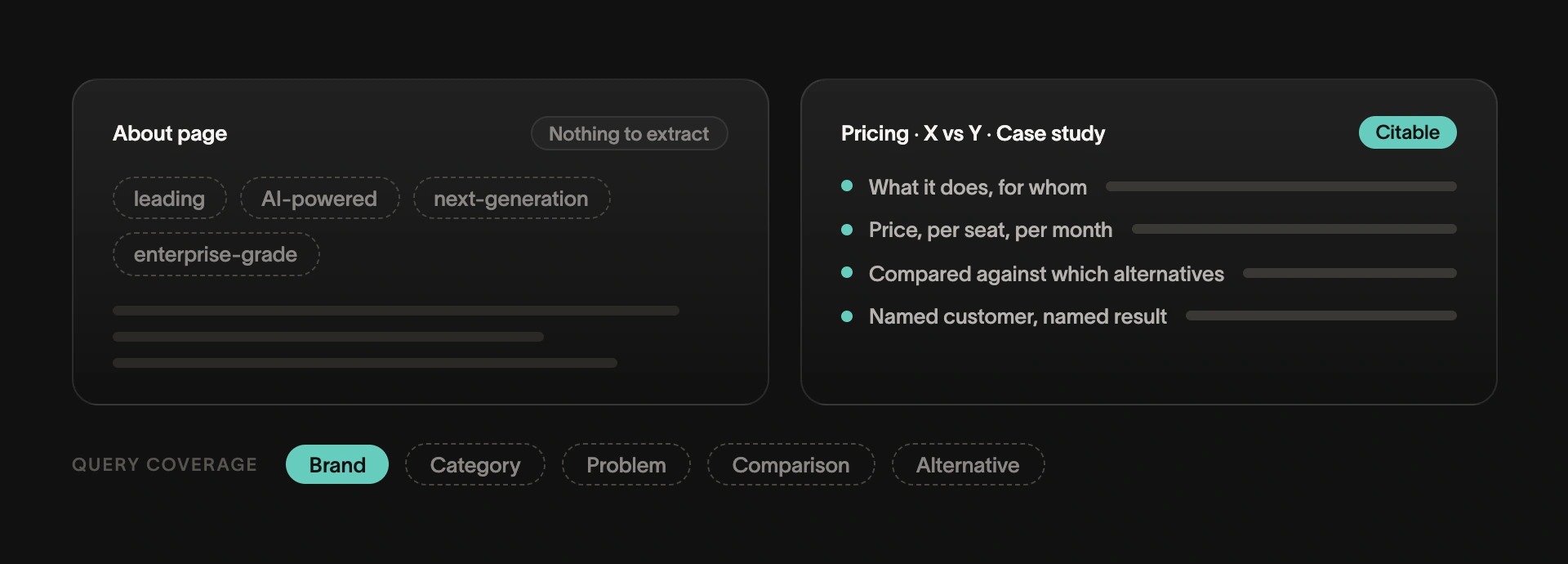
The Growth with Alex newsletter puts it bluntly: "LLMs don't learn from 'We're the leading AI-powered platform for enterprise growth.' If your About page sounds like a pitch deck, AI won't cite you." Superlatives, vague category language, buzzword density: all of it reads as noise to a model looking for citable statements. A page that says what you do, for whom, at what price, compared against which alternatives, gives the model material to work with.
The data on which content types earn AI referrals backs this up. Gushwork's analysis of B2B referral patterns found that comparison pages ("X vs. Y"), pricing pages, and case studies generate the strongest AI referral signals. These pages carry the exact facts a model reaches for when a buyer asks a vendor question. The engines even diverge on page type: ChatGPT cites product pages in 20.1% of responses; Perplexity, in 0.4%. Fifty-fold differences like that reward teams who cover several formats rather than betting one page on one platform.
Now map your content against the five query types buyers actually use: brand queries, category queries, problem queries, comparison queries, and alternative queries. Most startups have content for exactly one of those. Brand. The one query type where you were already going to be found. The other four are where shortlists get built, and most startups are silent there.
Check 3: do you exist anywhere other than your own domain?
This is the hardest check to pass and the one that separates bucket one from bucket three.
Growth with Alex again: "LLMs weight external validation heavily. If you only exist on your own website, you have weak signal. G2, Capterra, Product Hunt, niche newsletters, Reddit threads, podcasts — these are the sources LLMs are pulling from. If you're not there, you're not getting cited."

The mechanism compounds for young companies. A brand with no Wikipedia page, no review coverage, and a launch date after the model's training cutoff. That brand fails every discovery path at once. The model never trained on it, retrieval finds no third-party sources about it, and no reviewer has vouched for it.
That description fits an uncomfortable share of recently funded AI startups. In our own sales conversations at Noco, the moment a company finally confronts this tends to arrive at one of two points: a product launch with a date attached, or the realization that it has outgrown a founder-built or messy WordPress stack that was never designed to carry positioning, comparison content, or a citable footprint. Both moments share a trait. The company has been heads-down building for two years while its external footprint stayed frozen at seed-announcement level.
Fixing this third check takes months of earned coverage: review profiles, comparison mentions, community presence, podcast appearances. Slower than a robots.txt edit. Also the layer that most determines whether a model recommends you unprompted.
What happens after you diagnose, and why challengers win this one
Here is the finding that should change your mood about all of the above. The Princeton GEO research presented at KDD 2024 found that lower-ranked sites in traditional search benefit significantly more from generative engine optimization than top-ranked sites do. Your established competitors earned their AI presence through a decade of accumulated coverage. You cannot replicate that history, and you do not need to. Citation frequency responds to citable content and third-party signal, and a challenger who builds both deliberately can show up in answers alongside companies fifty times its size.
We have watched this play out. A creative Gen-AI company came to us invisible in the exact category it was built to serve. Eight months after the website rebuild and a bunch of changes, LLMs were sending it real, high-intent traffic. Our method is not glamorous or anything: extractable facts on every key page, comparison and pricing content that answers the queries buyers actually type, and a site structure AI crawlers can parse cleanly. We build the same way for ourselves. AEO is designed into noco.agency.
Timeline expectations, honestly stated: checks one and two respond within weeks of fixing. Check three takes months, because third-party credibility takes time to build.
When should you NOT obsess over AI visibility?
An honest audit includes the case against the audit. Three things the hype version of this article would leave out.
Organic search still dwarfs AI referral by volume. Across 53 B2B SaaS brands tracked for 8 months, organic drove 91.3% of all traffic and 37 times more leads than every AI engine combined. AI referral sits under 1% of total traffic for most sites, even after roughly 700% year-over-year growth. GEO complements SEO. Anyone advising you to redirect your whole content budget toward chatbot visibility is selling something.
AI referral traffic may currently be shrinking. US GenAI referral traffic to websites fell 15% between October 2025 and January 2026, from 267.4 million visits to 226.8 million. The honest case for acting now is shortlist presence, which the buyer-behavior data supports. A traffic curve that dropped 15% in a quarter supports nothing.
Measurement is unreliable. Academic work on GEO flags that single-point-in-time measurements are unstable because the systems themselves vary run to run. A meaningful share of AI traffic is also dark: the ChatGPT mobile app and browsers like Brave often strip referrer headers, so your analytics undercount what AI already sends to you. Treat your three-bucket result as a directional diagnosis you re-run monthly. Treat anyone promising a guaranteed AI ranking with suspicion, since the thing they are promising does not structurally exist.
One caveat on shortcuts. AI visibility is earned through genuine third-party credibility and clear, citable content. Bought links do nothing for citation frequency. Keyword stuffing does nothing either. The work is real, which is exactly why the earlier named 87-point spread between companies exists.
Run the audit with us
We do a 20-minute AI-visibility walkthrough: your prompts, your category, your bucket, live. You leave with the three checks scored and a plain answer on whether this is a one-line fix, a content problem, or a footprint problem. No deck, no pressure. Book the walkthrough.




Make your next move. Today.
Momentum is created in the first conversation. When the energy matches, everything else accelerates.

.webp)

Frequently asked questions.
How do I check if AI tools can even see my site?

Is AI-referred traffic worth chasing if it's under 1% of my visits?
Why does my competitor appear in AI answers when I don't, if we launched around the same time?
Can I fix this myself or do I need a rebuild of my website?

Amsterdam, NL





