

-p-500.webp)


Figma vs Claude Design: You're Comparing Tools. You Should Be Comparing Phases.


Every few years a tool arrives that makes a whole profession briefly re-litigate its own value. Claude Design is the current one. Since Anthropic shipped it, the comparison has hardened into a single question: does this kill Figma? That question is close to useless, because it assumes the two tools are competing for the same hour of your week.
They aren't. One is built for the hour where nothing exists yet. The other is built for the eighteen months after that.
That distinction sounds like a diplomatic non-answer. It isn't. It's the only framing that survives contact with an actual product team, and getting it wrong has a cost that shows up on an engineering timeline about four months later.
What Claude Design actually does
Claude Design launched on 17 April 2026 as a research preview under Anthropic Labs, running on Claude Opus 4.7, and it's bundled into paid Claude plans rather than sold separately. You describe what you want (or hand it a document, a screenshot, a URL, a repo) and it returns a working prototype, a deck, a landing page, a one-pager. You then refine it in conversation: inline comments, direct text edits, generated sliders for spacing and colour. Finished work exports to Canva for polish, or ships to Claude Code to become production components.
The interesting part is the onboarding. Claude Design ingests your codebase, your Figma files, your fonts and logos, and derives a design system from them, covering colours, type and component patterns, which it then applies to everything you make afterwards. You can maintain more than one, and refine them over time.
That detail matters, because it invalidates the laziest criticism of the tool. The standard objection, that a prompt has no idea what your button component looks like, is simply out of date. It does. That was the obvious first thing to fix, and it got fixed at launch.
So if you want to argue that Figma still matters, you have to argue it on harder ground.
Why the market reacted, and why that told you nothing useful
Figma's stock fell within hours. VentureBeat framed the launch as a direct assault on Figma's territory and as evidence that Anthropic is walking from model provider into the application layer where Figma, Adobe and Canva live.
Both readings are defensible. Neither is a workflow argument.
A share price is a bet on where attention and revenue drift over several years. It moves on narrative, on the plausibility of a future, and it moves fast because it has to. The question a design lead answers on a Tuesday is different in kind: given this brief, this team, this deadline, where does the work actually live? Those two questions have almost no overlap, and treating a market reaction as an answer to the second one is a category error that a surprising number of think-pieces have made.
Where prompt-first output runs out of road
The limits show up not at screen one but somewhere around screen twenty, when the work stops being a demonstration and starts being an asset multiple people maintain.
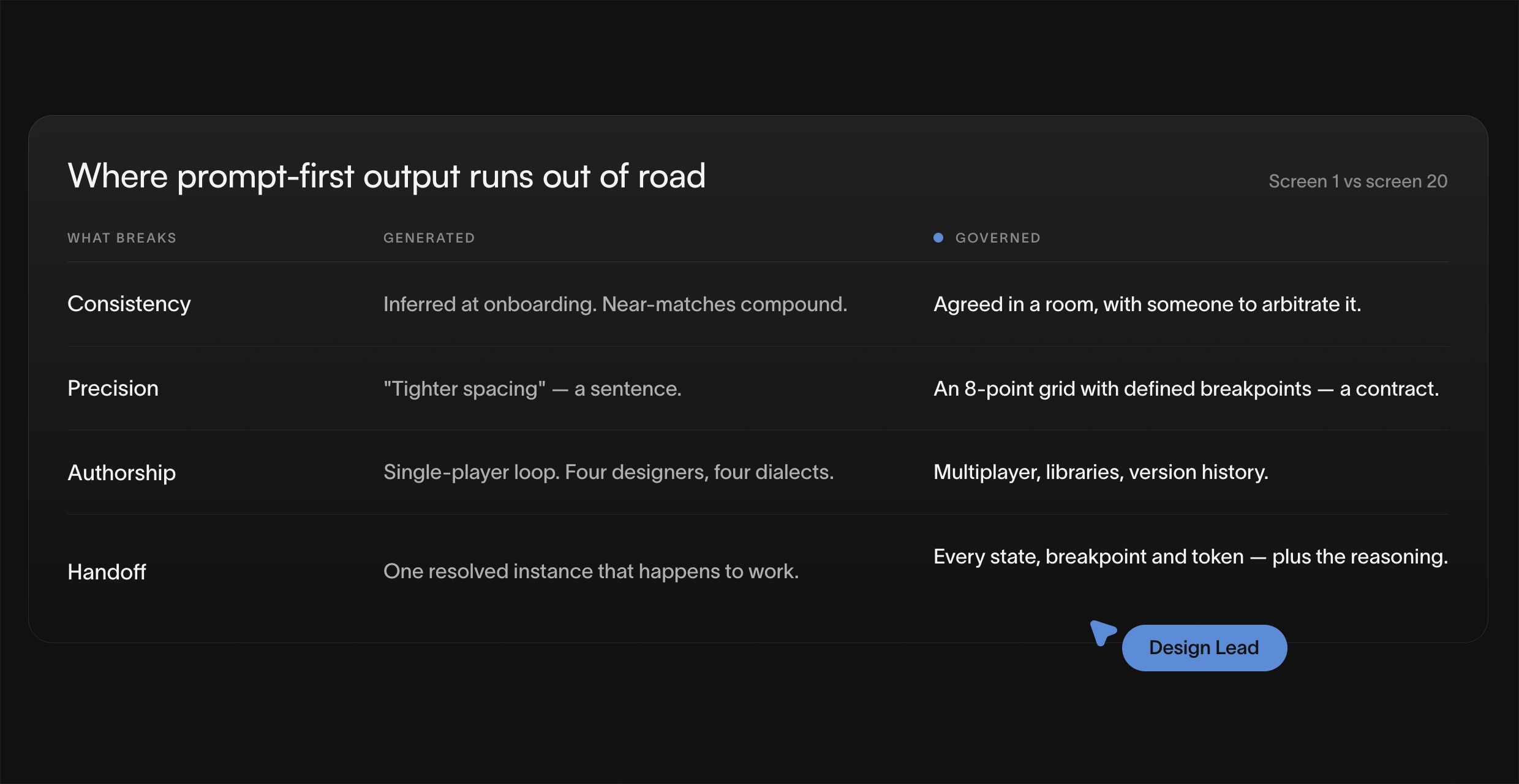
Generated consistency isn't governed consistency. A derived design system is a strong starting point, but it's inferred, not agreed. Nobody argued about it in a room. When a new state doesn't fit (an error variant, a dense table on mobile, a component that needs to behave differently in two contexts) a system that was inferred has no owner to arbitrate it. Somebody generates a near-match, and near-matches compound.
Conversation is a poor medium for precision. Describing an outcome is fast. Specifying one is not. "Tighter spacing" is a sentence; an 8-point grid with defined breakpoints is a contract. The first gets you something that looks right in a demo. The second gets you something that survives real content, real localisation, and a component library used by people who weren't in the conversation.
Authorship doesn't distribute. Prompting is fundamentally a single-player loop. Four designers prompting in parallel against the same product produce four dialects of it. Figma's multiplayer model, libraries and version history exist because that specific failure is the default state of any team larger than one.
Code output is not a specification. Handing a prototype to Claude Code is a genuine improvement on pasting screenshots into a Jira ticket. That's real, and it's underrated. But a prototype describes one resolved instance. Engineers building a system need the rules behind the instance: every state, every breakpoint, every token, and the reasoning for the ones that look arbitrary. Code that works isn't the same artefact as a spec that generalises.
What Figma is actually selling
Here's the part most comparisons miss. Figma's product isn't a canvas. Canvases are cheap, and have been for years. Figma's product is institutional memory with a UI on top.
It's the record of every decision your team already made, in a form that constrains the next person who opens the file. It's why a designer joining in month nine can ship something that looks like it belongs. Component libraries, published variables, version history, branching, comment threads that survive the meeting: none of that is drawing. All of it is agreement, made durable.
Prompt-to-prototype tools compress the distance between idea and artefact. They do not compress the distance between artefact and agreement, because that distance is made of people, and it's the expensive part.
The failure mode worth naming
The risk isn't that Claude Design produces bad screens. In our experience it frequently produces better first drafts than a rushed designer under a Friday deadline.
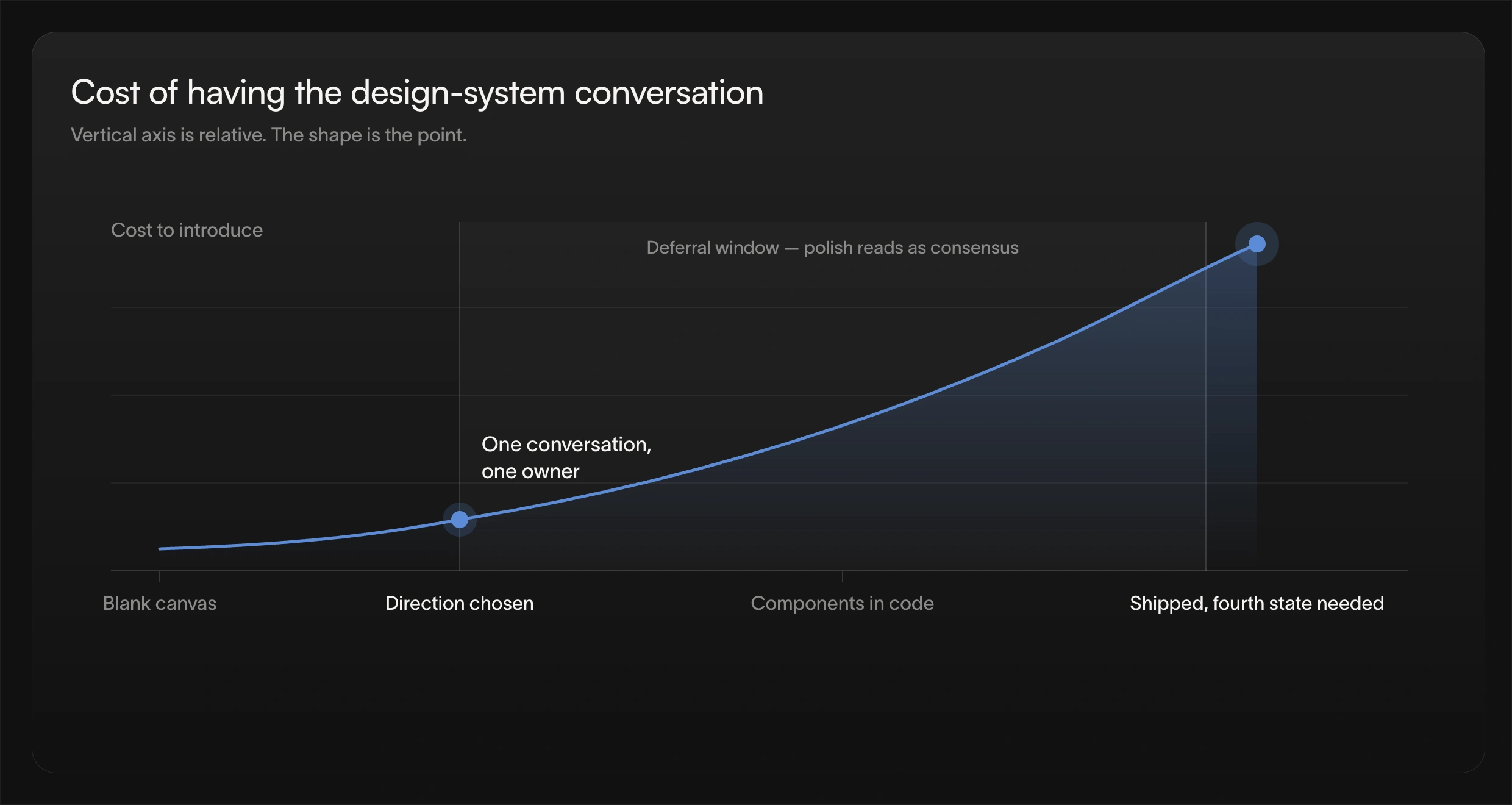
The risk is that it lets a team defer the design system conversation past the point where deferring it is cheap, and it does so invisibly, because the output looks finished. There's no visible seam where the missing decisions should be. Prototypes have always been provisional; the difference now is that provisional work has a production-grade finish, and finish reads as consensus even when there isn't any.
We see the result regularly: a founder arrives with an impressive AI-generated prototype, a hard launch date, and no answer to what happens when this needs a fourth screen state. The prototype isn't the problem. The absent scaffolding underneath it is, and retrofitting scaffolding onto shipped code is one of the most reliably expensive things a product team can do.
A division of labour that actually works
- Claude Design for divergence. Exploration, stakeholder alignment, pitch material, killing weak concepts before anyone invests in them, getting six options in front of people in an afternoon rather than one option in a week.
- Figma for convergence. The moment a direction is chosen and more than one person will touch it, the work moves, and the system conversation happens there, deliberately and early.
- The transition is a decision, not a drift. Name the moment. "This is now the direction" should be an explicit event with a named owner, not something you notice three sprints later.
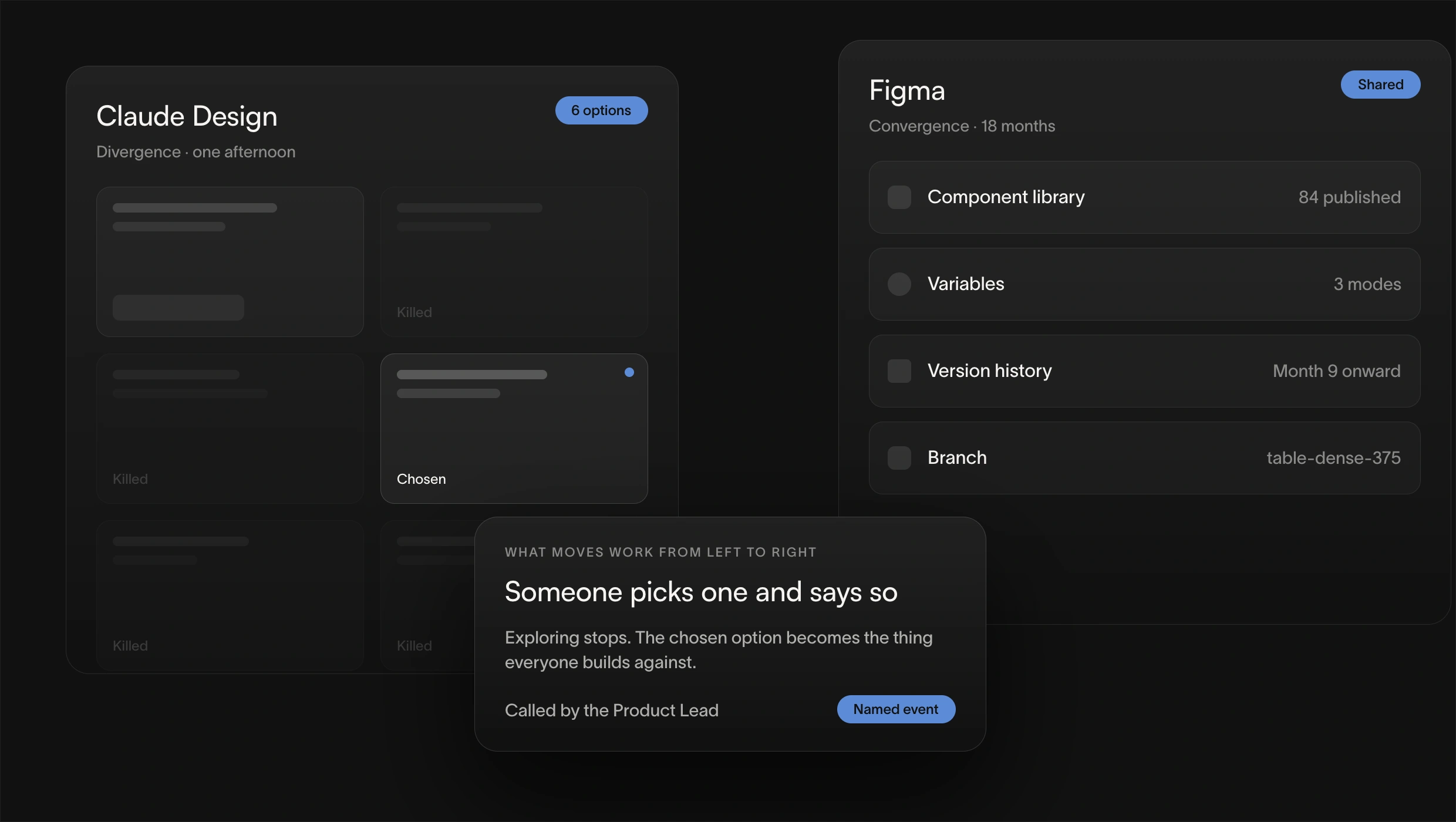
Used that way, the tools stack rather than compete, and the failure mode above mostly disappears.
The honest verdict
If you need to make an idea real by Friday and you've never opened a design tool, Claude Design is the best thing that has happened to you in a decade. Use it without guilt.
If you're building something that has to survive its own second version, with a team, a backlog, and engineers who need to know what happens at 375px, then the tool that matters is still the one holding the agreements together. Claude Design is a very good front door. Figma is still the load-bearing wall.
The interesting question was never which one wins. It's whether your team knows which one it's standing in.




Make your next move. Today.
Momentum is created in the first conversation. When the energy matches, everything else accelerates.

.webp)

Frequently asked questions.
Does Claude Design replace Figma?

Does Claude Design understand our existing design system?
Should an early-stage startup skip hiring a designer?
Why did Figma's stock drop?
What's the actual risk of designing with AI tools?