



-p-500.webp)


Why demo requests fall after a redesign, and how to find the real cause


A B2B SaaS company came to us this summer with a sequence we keep hearing. They shipped a redesign in late 2024. Demo requests fell. The internal team ran conversion experiments for months and produced small gains. Now the CEO wants an explanation, and the marketing lead is expected to deliver one backed by something firmer than a feeling that the new site "tells the story better."
The tempting move is to skip to the verdict: the redesign broke something structural, so plan a structural fix. That verdict is often right. Asserted without elimination, it is also indefensible in a leadership meeting. Someone will ask whether you checked the tracking. Someone will ask what the rest of the market did over the same period. Without answers, the diagnosis dies in the room.
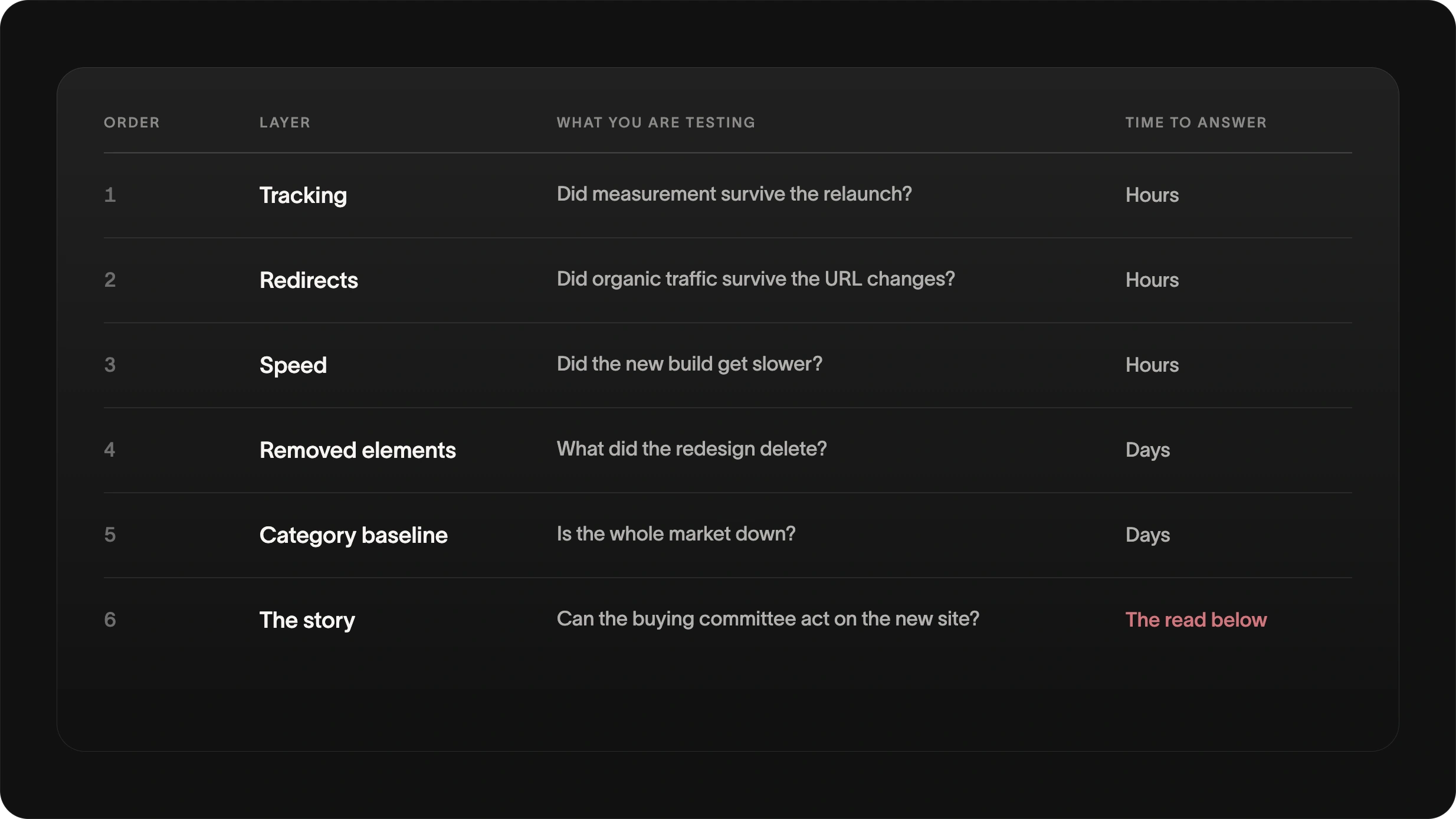
So run the checks in order. The order below is arranged by cost: cheapest and most falsifiable first, the expensive conclusion last, earned.
Why the cheapest checks come first
Because most post-redesign drops have boring causes, and boring causes are fast to confirm or kill. One agency audited pre and post performance data across more than 60 of its own customer redesigns over a 12-month window and found fewer than a quarter produced a measurable conversion improvement. Most changed nothing. The decreases traced back to two things: page speed regression on the new build, and content elements removed because they looked cluttered. Nobody had checked what those elements were doing commercially.
Notice what that finding contains. Two of the most common causes of a post-redesign drop are tactical and fixable within a week. Ruling them out costs almost nothing. Concluding "structural problem" while a four-second render sits unexamined costs you your credibility, and possibly a six-figure rebuild aimed at the wrong target.
Layer 1: prove the drop is real
Relaunches routinely break measurement. Form IDs change, GA4 conversion definitions point at retired elements, a thank-you page moves and the goal fires into nothing. Verify that a demo request today registers the same way one did before the relaunch. Then segment the drop by channel, landing page and device. A decline that only exists on paid mobile traffic is a different problem from a decline across every segment. If tracking is broken, stop here. There is no diagnosis until there is a measurement.
Layer 2: check the redirect map
Redesigns that remove pages, change URLs without proper 301 redirects, or rewrite content that was ranking can destroy organic traffic within weeks. Pull traffic by URL, pre and post. If ten pages carried most of your organic entrances and three of them now 404 or redirect to the homepage, your demo drop may actually be a traffic drop. This check is standard practice in every platform migration for the same reason.
Layer 3: measure the speed regression
Speed regression was one of the two typical causes in that 60-project audit. New builds ship heavier: bigger hero media, more animation, more scripts. Compare Core Web Vitals against your archived baseline, and test the worst offenders on real mobile connections. A regression here is the cheapest recovery available anywhere in this sequence.
Layer 4: inventory what the redesign deleted
The second typical cause. Proof page deleted. Comparison table retired. Case study library folded into a carousel. Pricing signals swapped for "Talk to sales." Design guidance through 2024 and 2025 pushed hard toward minimalism, and almost none of it explained how to tell a decorative element from a load-bearing one. List every element the old site had that the new one lacks, and ask a commercial question of each: what was this doing for a visitor who was three weeks into an evaluation? The elements that qualified visitors and carried proof are the usual casualties, because they are the ones that look busiest.
Layer 5: compare against the category baseline
Your demo volume may have declined whether or not you redesigned. One vendor's benchmark data across its B2B SaaS landing page cohort has median form completion falling from 4.7% in 2022 to 2.1% by early 2026. The same vendor sells conversational intake, the product that replaces the form, so treat the numbers as directional. The direction has company: a 2025 survey found 47% of companies reporting fewer B2B SaaS leads despite stable marketing budgets, and zero-click search climbed over the same window as AI answers absorbed queries that used to land on your site. If your peers are down 30% and you are down 35%, the redesign explains five points, and the plan changes accordingly.
What do your CRO team's small gains actually prove?
They prove the method worked, and that the problem sits somewhere the method cannot reach.
The win rates are on the record. One CRO firm audited its own history of 2,288 A/B tests across 71 engagements and found 19.1% produced a statistically proven winner. An experiment database covering more than 90 European e-commerce brands puts the share at 36.3%, with the median winning test moving conversion by 1.88% over a median duration of 42 days. The spread between those figures is definitional, and both come from e-commerce and mixed portfolios where traffic is plentiful. B2B lead generation sites run on far less, so their numbers skew worse. One testing source works the arithmetic: at 500 weekly users and a 2% baseline conversion rate, a single test needs around 16 weeks to detect even a 50% improvement. Below roughly 50 conversions a week, formal testing stops being practical at all.
Now run the numbers on a typical B2B site. Treat this as illustration: the inputs are industry averages and your numbers will differ. At 8,000 monthly sessions and a 2% demo rate, you book 160 demos a quarter. A disciplined internal program manages perhaps eight tests a year at that volume. At a one-in-five win rate, that yields one or two winners annually, each moving conversion by around 2%. The recoverable amount is a handful of demos a year. Against a redesign that took out a third of demo volume, that is a rounding error.
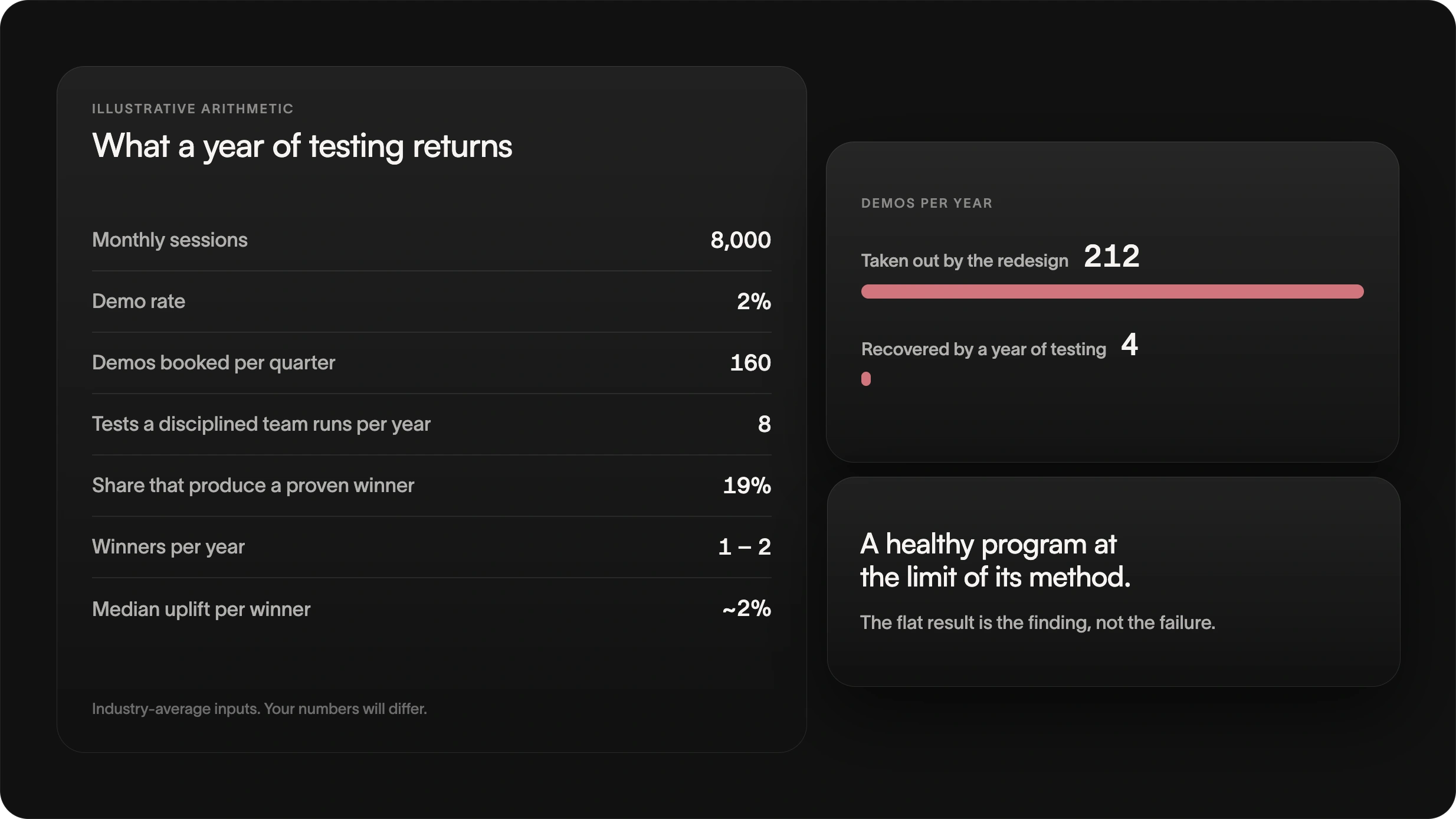
So read "small gains" as a healthy program at the limit of its method. Your team was mis-briefed, handed a structural question the instrument cannot answer. Their flat results now carry diagnostic weight. Five layers ruled out, plus a correctly run testing program that found nothing large: the explanation has one place left to live, above the component layer.
Why A/B testing can't catch a structural problem
The sixth layer is whether the redesigned site still gives a buying committee what it needs to reach consensus. No A/B test can measure that.
Gartner's research on the B2B buying journey puts the typical buying group for a complex purchase at six to ten decision-makers, and finds buyers spend only about 17% of their total purchase time meeting with vendors, split across every vendor under consideration. Forrester's 2024 State of Business Buying report counts 13 stakeholders, with 89% of buying decisions crossing multiple departments. In a six-month cycle, most of the evaluation happens on pages your champion forwards to people you will never meet. The economic buyer who opens a forwarded page and finds no defensible number does not fill in your form. She kills the deal in a meeting you are absent from, and your analytics record nothing.
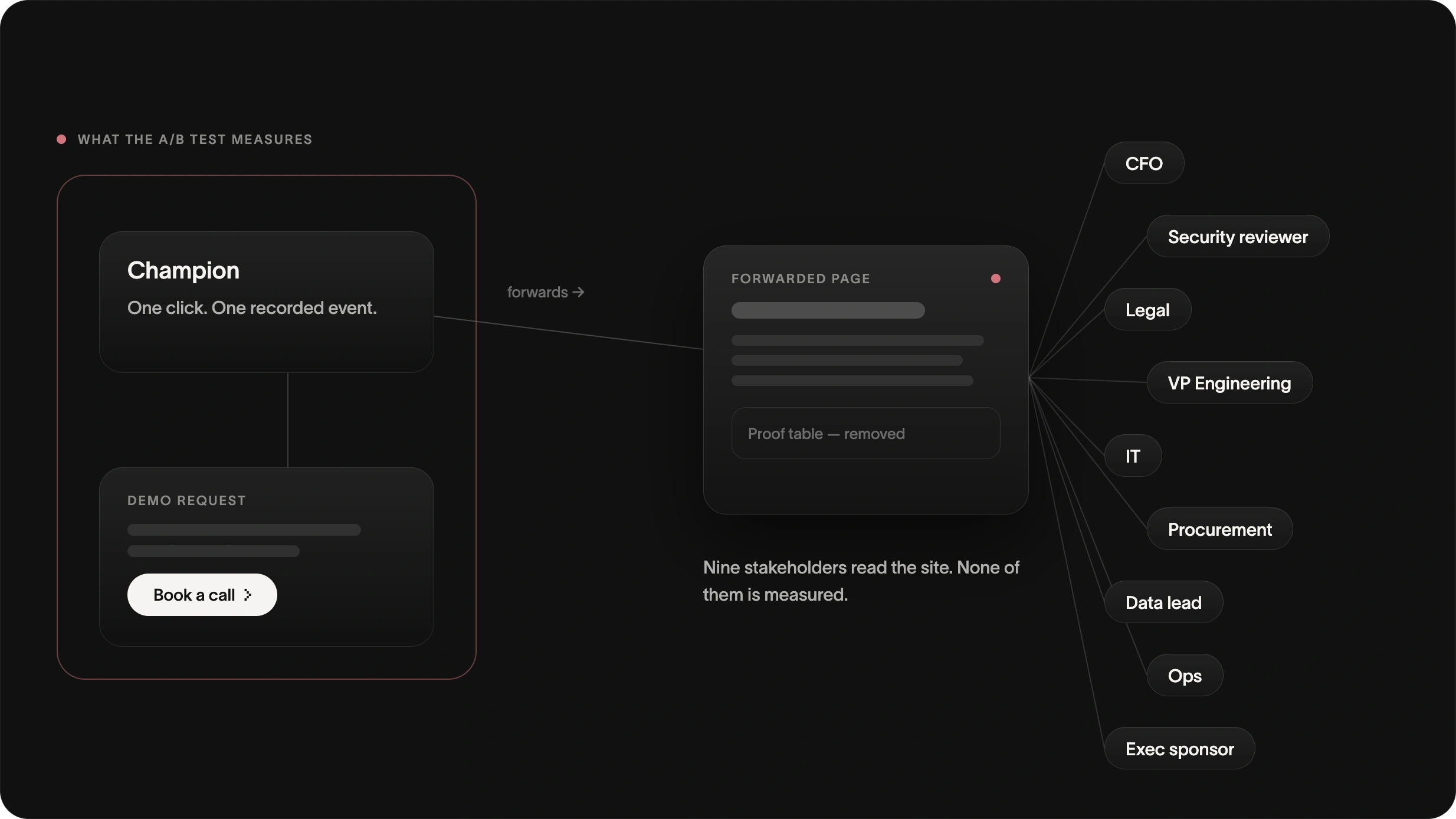
A demo-request A/B test measures the champion's click. It cannot measure whether the CFO found an ROI argument, whether the security reviewer found the integration specifics, or whether the deleted comparison table was the thing that let a committee shortcut three weeks of internal debate. Redesigns land on exactly this layer. The recent wave of minimalist rebuilds softened headlines, abstracted messaging and stripped proof. Every one of those changes hits the committee hardest, because the committee is the audience that needed the specifics.
A/B testing can tell you which of two answers performs better. A redesign is precisely the event that changes the question.
How we read the structural layer
When the five layers come back clean, the next step is a read. Two inputs, both of which we ask for before scoping any component work: GA4 behavioral reports, and the current sitemap with confirmed page volume.
The behavioral read asks where committee-stage visitors actually go. Direct-traffic entrances deep in the site are the tell for forwarded pages. Return visits in weeks two through twenty of a cycle show you which pages carry the evaluation. The structural read lays the sitemap against the buying journey and marks which stakeholder each page serves. Most post-redesign sitemaps show the same picture: a strong top of funnel for the first-time visitor, and almost nothing for the CFO, the security reviewer, or the champion assembling an internal case. We map the buying group at the start of every engagement because designing for the wrong audience blurs everything downstream: the headline, the proof, the CTA.
The fix that follows starts with the narrative, not the components. The mechanism is a decision about what the site argues and to whom: reframing messaging around the buying pain that actually stalls the deal, then making the site say it consistently across every page a committee touches. Component testing enters afterwards, on top of a structure that already holds.
To be plain about our own model, since we sell a CRO subscription: testing earns its keep as a continuation layer on a site whose structure is already sound, where volume supports it, and where each test targets a big swing like a headline or an offer. That is why we set up tracking, dashboards and the testing workflow before launch on the sites we build. The tests inherit a sound structure. Asking them to compensate for a broken one is how a competent team ends up reporting small gains for six months.
When to skip this diagnostic
If demo requests were near zero before the redesign, your constraint is demand, and no diagnostic on the site will manufacture traffic. If the tracking check in layer one fails, fix measurement first and re-baseline for a month before concluding anything. If the drop is under 10% and under two weeks old, wait. Small dips after any relaunch are normal and usually recover. And sometimes layer three or four simply is the answer: a speed regression or a deleted proof page needs a ticket and a week, and deserves no strategy deck. The structural conclusion belongs to teams who ran the sweep honestly and still came up clean.
If that is where you are, with a drop you can prove, a clean tactical sweep, and a deadline to explain it, this sequence is the first step of how we scope. Book an intro call and bring two things: GA4 access and your sitemap. The read comes before any proposal.




Make your next move. Today.
Momentum is created in the first conversation. When the energy matches, everything else accelerates.

.webp)



Frequently asked questions.
Do you run A/B tests?

How do I know if the redesign actually caused our drop in demo requests?
Why did our internal CRO tests only produce small gains after the redesign?
What data should we gather before diagnosing a post-redesign conversion drop?
Can A/B testing recover demos lost to a redesign?


Who Are You Actually Designing For? The Question B2B SaaS Teams Get Wrong
Most SaaS teams design for the user and miss the buyer entirely. This article breaks down the difference between user and customer in B2B SaaS, why personas fall short, and what it means for your website, messaging, and conversion rate.


Why B2B SaaS teams are leaving WordPress for Webflow
WordPress built the modern web. But for B2B SaaS teams that have outgrown it, the platform is becoming a liability. Here is why more and more of them are making the switch to Webflow, and what it actually takes to do it right.

Amsterdam, NL





